

How to Host Your Own AI Agent Instead of WhatsApp Business API
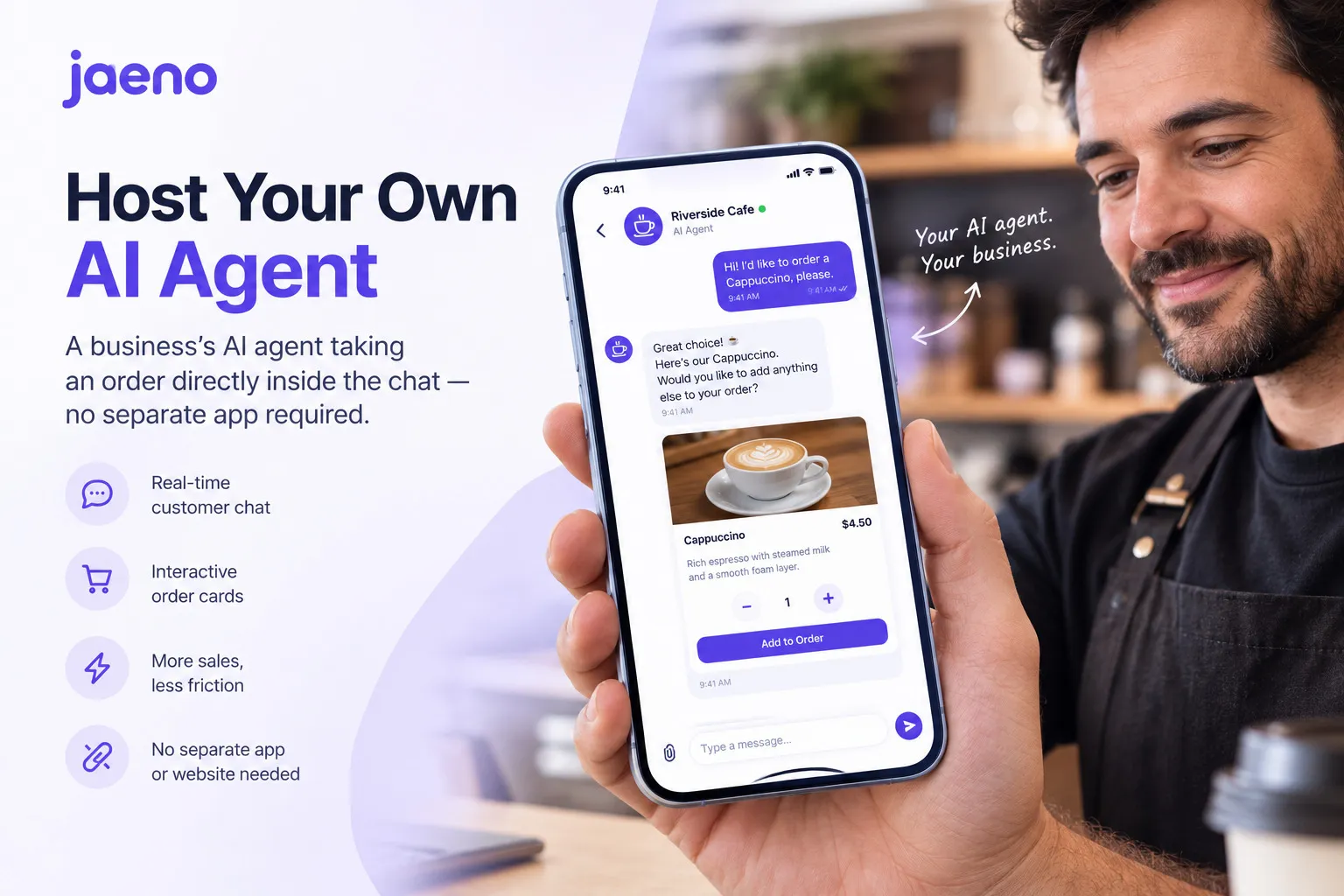
Hosting your own AI agent means putting a business-trained assistant inside a single chat thread one your customers can message directly instead of renting space inside Meta’s WhatsApp Business API and paying per message for every reply it sends. As of October 2026, Meta has started charging for service replies that used to be free, which has pushed a lot of restaurants, clinics, and shop owners to look seriously at an alternative to WhatsApp for business. This guide breaks down what hosting your own AI agent actually involves, how the costs compare, and when it’s the right move.
What Does It Mean to “Host Your Own AI Agent”?
It means the business not the platform builds, trains, and controls the agent that talks to customers. The platform’s job is to give that agent somewhere to work: a chat thread, interactive cards for things like menus, orders, and bookings, and a way for customers to reach it without installing a new app for every shop they use.
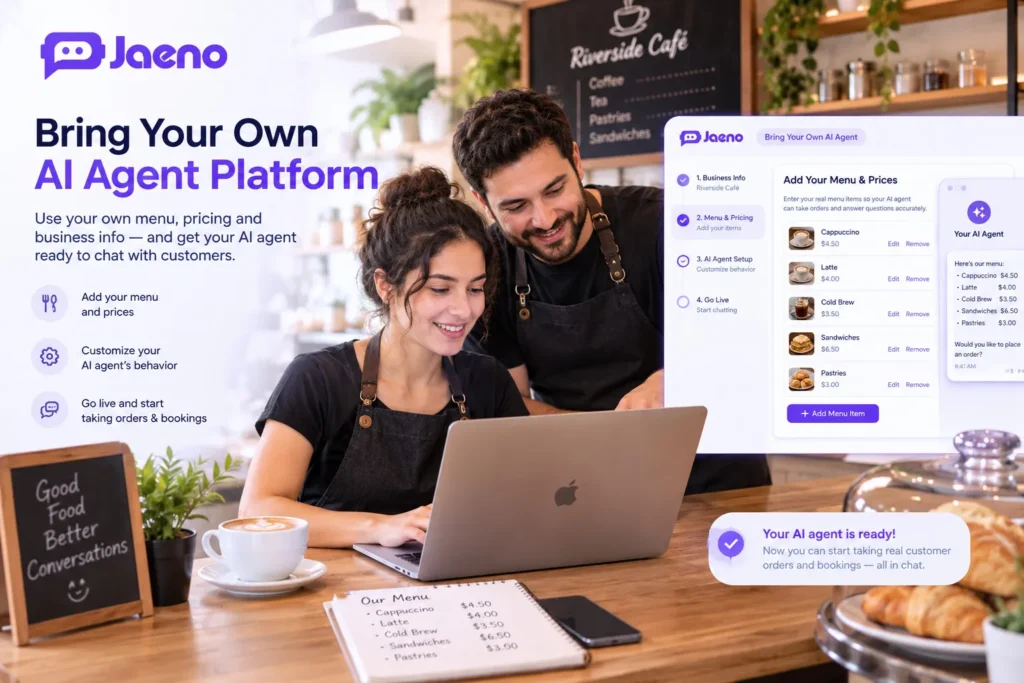
This is different from a generic chatbot bolted onto a website, and different from WhatsApp’s own automation tools, where the business is still operating inside Meta’s infrastructure, Meta’s approval process, and Meta’s pricing. A bring-your-own-AI-agent platform Jaeno is one example flips that: the business owns the agent’s training, tone, menu data, and policies, and the platform supplies the chat surface and the transactional tools around it (order forms, booking slots, payment links). Nothing about the business’s own catalog or pricing has to pass through a third party’s approval queue to go live.
Expert take: for a single-location restaurant or clinic, who owns the agent matters less day to day than whether it can actually finish a transaction take an order, confirm a booking inside the chat itself, rather than just answering questions and pointing the customer elsewhere.
WhatsApp Business API Limitations Business Owners Run Into
The short version: WhatsApp Business API is good at reach and bad at cost predictability and built-in transactions. Four limitations come up most often.
Per-message pricing now applies to nearly everything
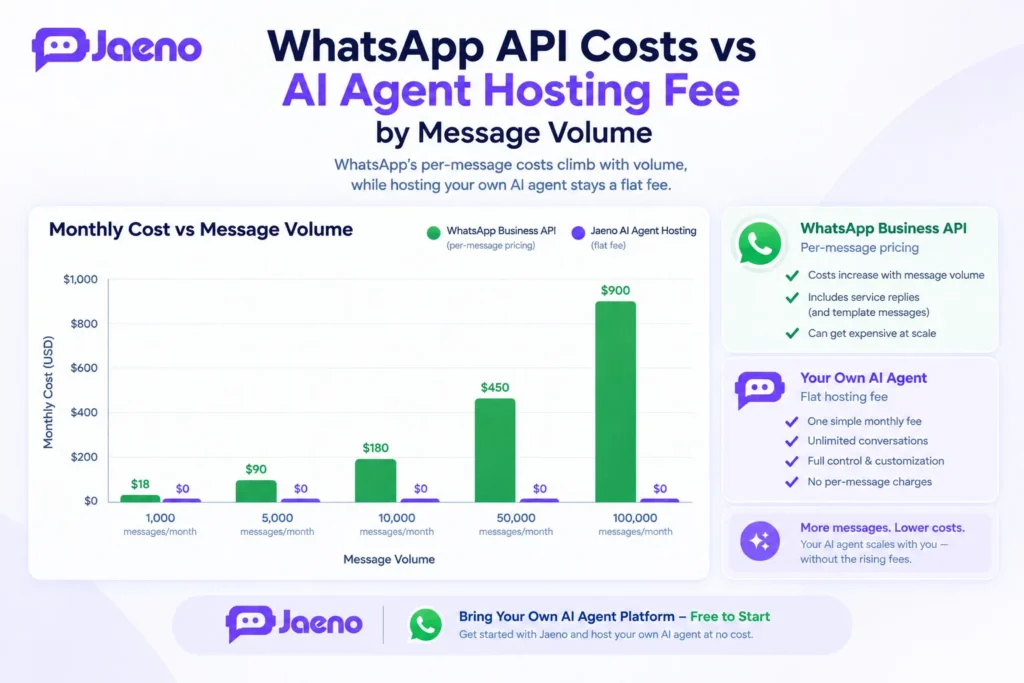
Meta moved template messages (marketing, utility, authentication) from per-conversation to per-message billing on July 1, 2025. Then, effective October 1, 2026, Meta began charging per message for service replies too the free-form messages a business sends back within the 24-hour customer service window, which had been free since November 2024. Each WhatsApp Business Account now gets 1,000 free service messages a month; every message past that is billed per delivery, at a rate set by the recipient’s country and the message category.
The 24-hour customer service window is a hard boundary
A business can only send free-form replies for 24 hours after a customer’s last message. After that, anything the business wants to send has to be a pre-approved template message which is its own cost and its own approval delay.
You need a verified Meta Business account and, usually, a Business Solution Provider
Very few small businesses integrate directly against Meta’s Cloud API. Most go through a BSP, which adds its own subscription fee, per-seat pricing, or markup on top of Meta’s rate card . so the number on Meta’s own pricing page is rarely the number a business actually pays.
Ordering and booking aren’t native
WhatsApp has list messages, reply buttons, and a basic product catalog, but there’s no built-in way to run a full order-with-cart-and-confirmation flow or a real appointment-booking flow inside the thread. Most businesses end up linking out to a separate ordering site or booking tool anyway, which defeats a lot of the point of staying in one conversation.
Pro tip: before switching anything, check how many service messages a WhatsApp Business Account actually sends in a typical month. A quiet local business well under 1,000 replies a month won’t feel the October 2026 change much yet; a business running daily order confirmations and reminders will clear that allowance fast.
WhatsApp Business API vs. Hosting Your Own AI Agent
| WhatsApp Business API | Bring-your-own-agent platform (e.g. Jaeno) | |
| Messaging cost | Per message, by country and category; 1,000 free service messages/month, then billed | Platform subscription/usage fee; no per-reply Meta charge |
| Who builds the agent | Business or its BSP, constrained by Meta’s template and policy rules | Business builds and trains its own agent directly |
| Ordering in-chat | List messages and basic catalog only; usually links out | Interactive cards for menu, order, and booking inside the thread |
| Setup path | Business verification + BSP or direct Cloud API integration | Business account + agent training, no Meta approval queue |
| Payments | Not handled by WhatsApp itself | Business connects its own payment gateway; platform doesn’t hold funds |
| Existing reach | Customers already have WhatsApp installed | Customers reach the business through the platform’s own chat |
The trade-off in one line: WhatsApp wins on reach because nearly everyone already has it installed; a bring-your-own-agent platform wins on cost predictability and built-in transactions, at the cost of needing customers to start a new conversation on a platform they may not already use.
How to Set Up Your Own AI Agent
- Pick a platform built for bring-your-own agents not one where the platform writes the agent for you. Check specifically that it supports interactive cards (menu, order, booking), not just plain text replies.
- Train the agent on your own data menu or service list, prices, hours, policies, and common questions. The more specific the training data, the fewer times it falls back to “let me check and get back to you.”
- Set up the transactional cards menu browsing, order building, and appointment booking, so the agent can actually finish a task instead of only answering questions.
- Connect your own payment gateway, if you take payments in-chat. A platform that doesn’t take custody of customer funds itself means you keep your existing merchant relationship rather than routing money through the chat provider.
- Test the full conversation path yourself ask it to take an order, book a slot, and answer an edge-case question before pointing real customers at it.
- Publish the chat link wherever customers already look for you: Google Business Profile, your website, social bios, and in-store signage.
Pro tip: for most small businesses, step 2 training data is where launches stall, not the technical setup. Writing out your actual menu, prices, and policies in plain language takes longer than connecting the platform itself.
Who This Is — and Isn’t — Right For
Hosting your own AI agent tends to fit best for businesses with repeat local customers who order or book regularly: cafés, restaurants, clinics, pharmacies, salons, and independent retail shops. These businesses benefit most from predictable costs at volume and from finishing a transaction inside one conversation instead of juggling a phone call, a booking site, and a payment link.
It fits less well for businesses that depend on WhatsApp’s existing installed base for cold outreach. A business running large one-off marketing blasts to people who’ve never interacted with them before will still get more reach through WhatsApp’s own user base than through a chat surface customers have to be pointed toward first. For most businesses, the two aren’t mutually exclusive: WhatsApp can stay the discovery channel while a self-hosted agent handles the actual ordering and booking.
Common Mistakes When Switching Away from WhatsApp
- Assuming the exact phone number and chat history carry over. They don’t a self-hosted agent lives on a different chat surface, so existing WhatsApp contacts need a new link or number to reach the new agent.
- Launching with a bare chatbot instead of transactional cards. If the agent can only answer questions and can’t take an order or a booking, it hasn’t actually replaced what WhatsApp was doing it’s just a slower FAQ page.
- Skipping payment gateway setup before go-live. An agent that can build a cart but can’t check it out just adds a step customers abandon.
- Underestimating training time. A thin menu or a handful of FAQ answers isn’t enough; expect to spend real time writing out the actual policies and pricing the agent needs.
- Expecting the new chat link to bring in customers on its own. It still needs to be discover able listed on Google, your website, and your socials the same way the business is discover able today.
Conclusion
WhatsApp Business API now charges per message for service replies, effective October 1, 2026. That’s the kind of change pushing business owners to price out alternatives for the first time. Hosting your own AI agent trades WhatsApp’s existing reach for cost predictability and full control over the agent’s training. It also adds transactional cards that can actually take an order or a booking inside the chat. It fits best for repeat-customer businesses cafés, clinics, pharmacies, restaurants, retail. If per-message costs are starting to add up, see how Jaeno works and what it takes to set one up.
FAQ’s
Is hosting your own AI agent cheaper than WhatsApp Business API?
It depends on the message volume. A business sending under 1,000 service messages a month on WhatsApp won’t hit Meta’s new per-message charges yet.A business sending thousands of confirmations, reminders, and replies a month will likely find a flat platform fee more predictable. Per-message billing scales with every reply.
Do I need to be a developer to host my own AI agent?
No, not on a platform built for this. Training an agent on your menu and policies is largely a content task. It’s about writing out what you already know about your business, rather than a coding task.. Direct integration against Meta’s own Cloud API is the option that typically needs developer involvement.
Can customers still reach my business the way they do now?
They can reach the new agent, but not through the same WhatsApp number or thread automatically. That’s a separate chat surface. You’ll need to publish the new chat link anywhere customers currently find you. Most businesses keep WhatsApp running alongside it during the transition.
What happens to customer data when I host my own AI agent?
That depends entirely on the specific platform’s data handling, which varies by provider. Check its privacy policy and data retention terms directly, rather than assuming it matches WhatsApp’s.
Does hosting my own AI agent replace WhatsApp entirely?
Not necessarily. Many businesses keep WhatsApp for the reach it already has. They use a self-hosted agent for the actual ordering and booking workflow. There, built-in transactional cards and cost predictability matter more than installed base.
About the Author
Written and reviewed by the Jaeno team.Jaeno gives businesses a place to put their own AI agent in chat. Customers can order, book appointments, and get answers in one conversation.