

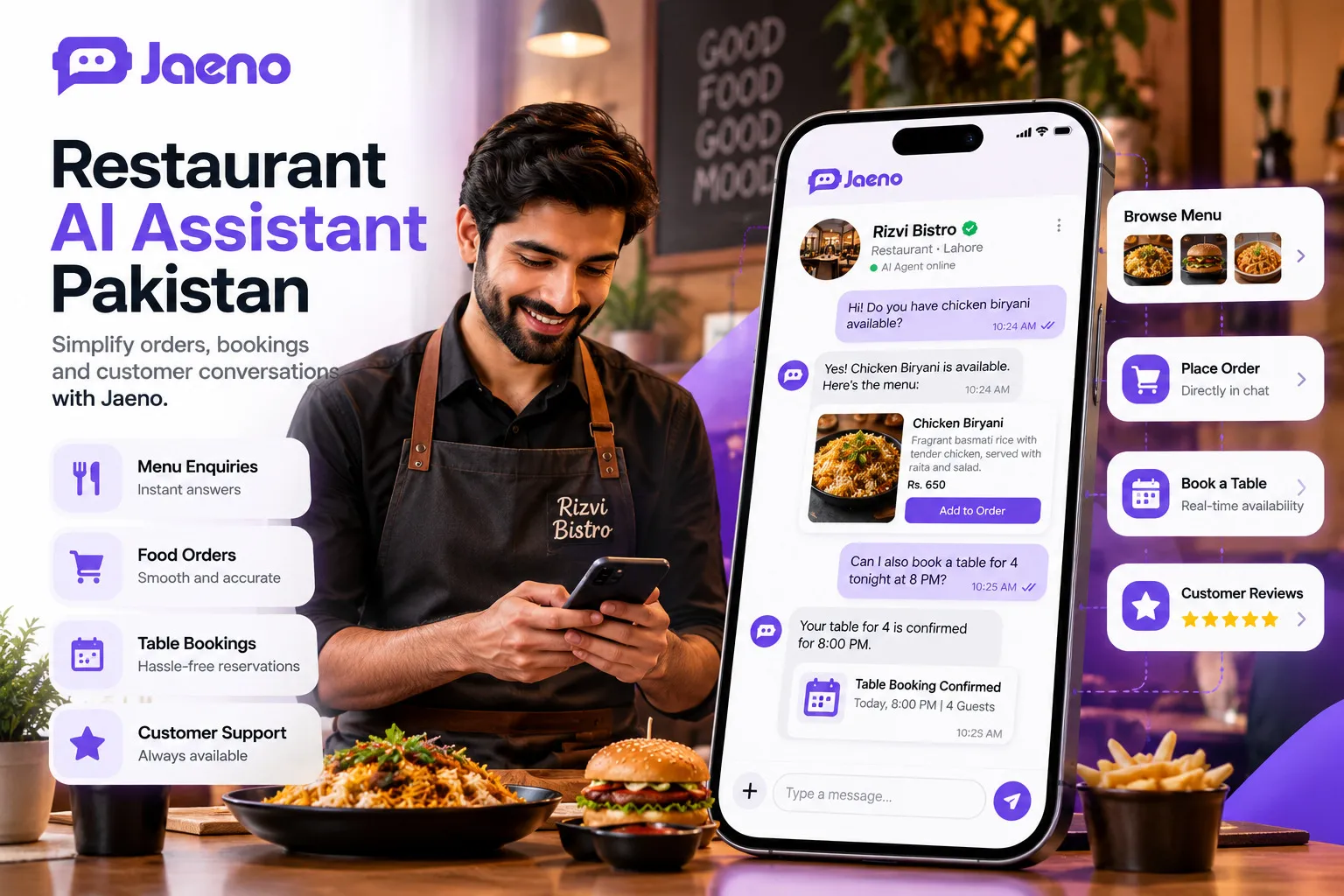
Restaurant AI Assistant Pakistan: A Complete Guide for 2026
Running a restaurant in Pakistan means handling much more than food preparation. Customers ask about menus, delivery areas, table availability, prices, and order status throughout the day. A restaurant AI assistant Pakistan businesses can configure for these requests may reduce repetitive work and improve communication.
From busy cafés in Lahore to family restaurants in Karachi, customer expectations are changing. People want quick answers and clear confirmations. However, restaurant owners also need accurate orders, manageable costs, and reliable service.
A restaurant AI assistant is software that helps food businesses answer enquiries, guide menu selection, and support ordering or reservations through conversational AI. Restaurants in Pakistan can connect suitable AI agents to supported communication platforms, including Jaeno, to manage customer interactions. Successful implementation requires accurate menus, approved workflows, human oversight, and reliable order confirmation.
Key Takeaways
- Restaurant AI assistants help handle repetitive customer enquiries and routine ordering tasks.
- Automated ordering depends on accurate menus, prices, availability, and confirmation workflows.
- Urdu, English, and Roman Urdu conversations require local testing.
- Human staff should manage unusual requests, complaints, and sensitive customer situations.
- Jaeno provides a business communication platform where restaurants can use their own AI agents.
What Is a Restaurant AI Assistant in Pakistan?
A restaurant AI assistant Pakistan restaurant owners can adopt is a conversational system designed to support customer communication and selected restaurant operations.
It can interpret customer questions, retrieve approved business information, and guide people through supported workflows. Depending on its configuration, it may also interact with ordering or reservation systems.
Unlike a basic automated chatbot, an AI agent can use connected tools to perform authorized tasks. However, its capabilities depend on the business information, permissions, and systems provided.
For example, consider a customer asking:
“Kal raat 8 baje 4 logon ki table available hai?”
A properly configured assistant should understand the request, check availability, and present suitable options. It must not confirm a reservation without checking the actual booking system.
AI Assistant vs Traditional Restaurant Chatbot
Traditional chatbots often follow predetermined questions and answers. AI assistants can interpret more flexible language and provide context-aware responses.
However, AI does not automatically make a system reliable.
A chatbot with accurate menu information may outperform an AI agent connected to outdated prices. Therefore, restaurants should prioritize dependable workflows over promotional claims about intelligence.
Where Jaeno Fits Into Restaurant Communication
Jaeno is a standalone business communication platform, not an AI agent.
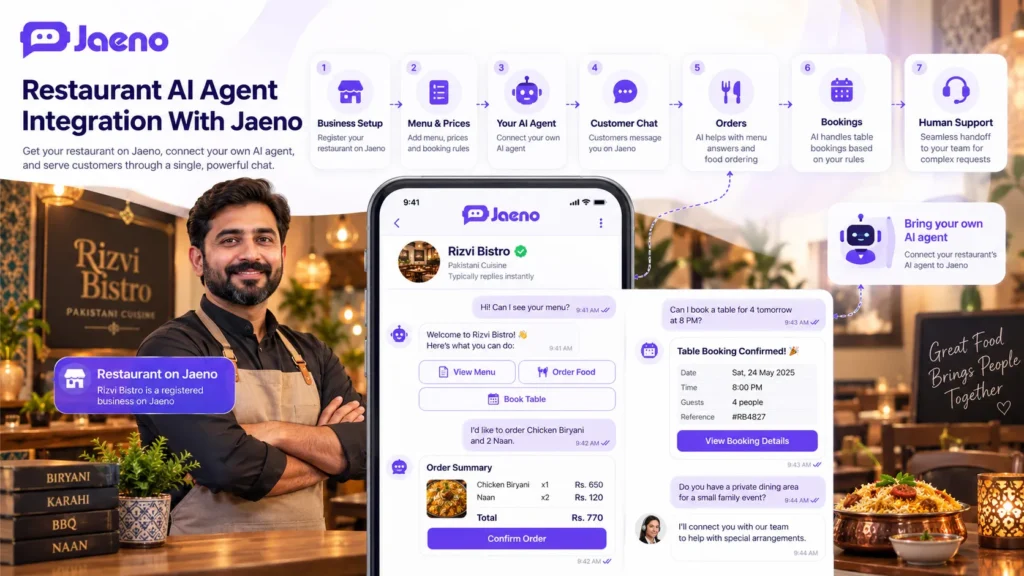
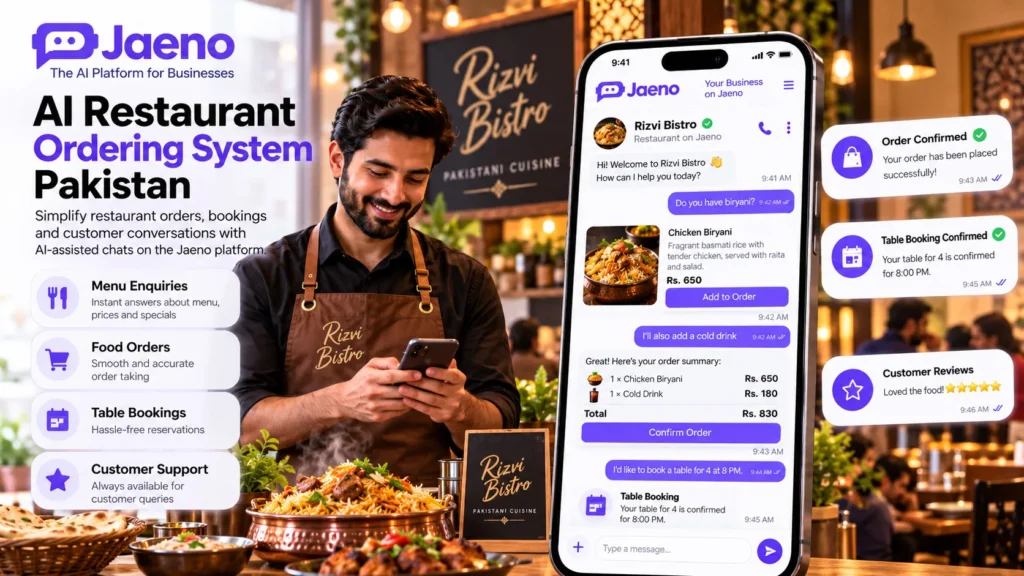
Restaurants can bring their own AI agents to serve customers through Jaeno chat. The platform supports business conversations and describes menu browsing, cart-based ordering, appointment booking, loyalty rewards, and customer reviews.
This distinction matters: the restaurant controls its AI agent, while Jaeno provides the communication experience and supported business workflows.
How Can a Restaurant AI Assistant Improve Daily Operations?
A restaurant AI assistant Pakistan businesses use should solve specific operational problems rather than simply greet customers automatically.
Automated Menu Enquiries and Order Management
Restaurant customers frequently ask about available dishes, portions, prices, and delivery options.
An AI assistant can answer these questions using an approved digital menu. Where connected ordering is supported, it can also guide customers through item selection and order confirmation.
Consider a café in DHA Lahore.
A customer requests two cappuccinos and a chicken sandwich. The assistant checks the available menu, presents the total, and collects the required order details.
However, staff must be able to update prices and availability. An unavailable item should never appear as confirmed.
For an effective ordering workflow:
- Maintain one accurate digital menu.
- Display prices in Pakistani rupees.
- Confirm product availability before accepting an order.
- Collect delivery or pickup instructions securely.
- Provide an order reference and clear confirmation.
- Escalate unavailable items or unusual requests.
Restaurant Reservations and Customer Questions
An AI-powered restaurant assistant can reduce repetitive reservation enquiries.
Customers may ask about table availability, opening hours, seating arrangements, or group bookings.
A connected booking workflow should offer verified slots and confirm a reservation only after the system records it.
Other common enquiries include restaurant location, parking facilities, takeaway availability, and dietary information.
For allergy-related questions, the assistant should use verified ingredient and preparation information. Uncertain answers must be referred to trained restaurant staff.
Loyalty, Reviews, and Repeat Customers
Customer retention matters for cafés, casual dining restaurants, and food chains.
After a completed order, a restaurant may invite customers to leave feedback or participate in an available loyalty program.
Jaeno publicly describes loyalty, referral rewards, and automated review collection as platform features.
However, owners should confirm eligibility rules, customer consent requirements, and program configuration before launching promotional campaigns.
The objective is useful follow-up, not excessive messaging.
Why Are Restaurants in Pakistan Exploring AI Customer Service?
Restaurant operators face practical communication challenges during lunch, dinner, weekends, and seasonal promotions.
A restaurant AI assistant Pakistan implementation may help organize repeat requests while staff concentrate on food preparation and hospitality.
In Lahore’s Gulberg and DHA neighborhoods, a busy restaurant might receive simultaneous booking and takeaway enquiries. Meanwhile, a Karachi delivery kitchen may need frequent order-status updates.
These examples illustrate operational needs rather than measured market-wide adoption.
Several factors make local implementation distinctive:
- Language: Customers may combine Urdu, English, and Roman Urdu.
- Pricing: Menus and service charges must display accurate PKR amounts.
- Delivery areas: Supported locations should be checked before accepting orders.
- Operating hours: Ramadan, holidays, and special events can change schedules.
- Menu availability: Stock can change during busy periods.
Therefore, generic AI responses are not enough. Restaurant-specific information must remain current.
According to the Punjab Food Authority, restaurants and food handlers have specific operational and hygiene guidance. AI-assisted communication should never replace applicable food safety procedures.
For nationwide restaurant chains, centralized menu governance can also reduce inconsistency. Nevertheless, individual branches must retain control over local availability and operating conditions.
How to Set Up a Restaurant AI Assistant Pakistan Businesses Can Trust
Implementing a restaurant AI assistant Pakistan restaurant teams can rely on requires preparation, testing, and ongoing ownership.
A small pilot is usually easier to manage than automating the entire customer journey immediately.
Step 1: Identify High-Volume Customer Requests
Review recent messages and customer calls.
Group them into menu questions, reservations, delivery information, complaints, and order tracking.
Choose a low-risk workflow with a clear result. For example, start with opening hours and menu enquiries before enabling confirmed orders.
Step 2: Configure Business Information and Permissions
Prepare approved menus, prices, opening hours, branch locations, and ordering policies.
Then define what the AI agent may do independently.
An agent might answer menu questions or initiate an approved booking. However, refunds, disputes, and exceptional requests should follow defined staff approval rules.
Customer information should also be limited to what each workflow genuinely needs.
Step 3: Connect the Agent to a Suitable Platform
Select a communication platform that supports the intended customer journey.
With Jaeno, the business can explore bringing its own AI agent into a dedicated chat experience.
Before implementation, verify onboarding requirements, available connections, pricing, permissions, and supported workflows directly with the platform.
Do not assume that every point-of-sale, delivery, or inventory system has an existing integration.
Step 4: Test Real Pakistani Customer Conversations
Test English, Urdu, and Roman Urdu requests using realistic spelling variations.
For example:
“Zinger burger available hai?”
“Kal 6 logon ki booking karni hai.”
“Order kitni dair mein pohanchay ga?”
Evaluate whether the assistant understands each request and avoids inventing stock or delivery information.
Test cancellation requests, allergy concerns, duplicate orders, and unavailable reservation times.
Step 5: Launch, Monitor, and Improve
Begin with a limited set of requests.
Monitor:
- Correctly confirmed orders
- Successfully completed reservations
- Inaccurate or incomplete replies
- Human escalation requests
- Customer complaints and corrections
For example, if 75 of 100 eligible enquiries are resolved accurately, the verified resolution rate is 75%. This is an illustrative calculation, not a performance benchmark.
Review failed conversations and improve the source information before expanding automation.
Conclusion: Make Restaurant Communication Simpler With Jaeno
A restaurant AI assistant Pakistan business owners implement should help customers complete meaningful tasks, not simply receive faster greetings.
Accurate menus, understandable conversations, reliable confirmations, and human assistance create a stronger customer experience.
Whether you manage a café in Lahore, a restaurant in Karachi, or multiple branches across Pakistan, start with one useful workflow and measure its performance.
Explore Jaeno to learn how your restaurant can bring its own AI agent into a dedicated business chat platform for supported orders, bookings, and customer conversations.
Frequently Asked Questions
What is the best restaurant AI assistant in Pakistan?
The best restaurant AI assistant depends on your menu complexity, customer languages, ordering process, and existing systems. Compare providers using real customer requests instead of feature lists alone. Jaeno is a communication platform that supports businesses bringing their own AI agents, rather than a standalone AI assistant.
Can an AI assistant take restaurant orders automatically?
Yes, if the AI agent has an approved ordering workflow and access to accurate menu information. The system should confirm item availability, quantities, prices, and customer details before finalizing an order. Unsupported delivery promises, incorrect totals, and uncertain requests should be escalated to staff.
Can restaurant AI assistants understand Roman Urdu?
Some AI systems can interpret Roman Urdu, but accuracy varies by model and configuration. Pakistani restaurants should test informal expressions, spelling differences, and mixed Urdu-English messages. A successful demonstration with a few examples does not guarantee reliable performance across all customer conversations.
How much does a restaurant AI assistant cost in Pakistan?
Pricing depends on the AI provider, model usage, integrations, setup work, and support requirements. Some providers charge subscriptions, while others include usage-based fees. Ask for a written breakdown covering implementation, conversation volumes, maintenance, and potential third-party costs before selecting a solution.
Is Jaeno an AI assistant for restaurants?
No. Jaeno is a business communication platform where restaurants can bring their own AI agents to interact with customers. Its published capabilities include chat-based ordering, bookings, loyalty features, and reviews. Restaurants should confirm integration requirements and availability before implementing their preferred AI agent.