

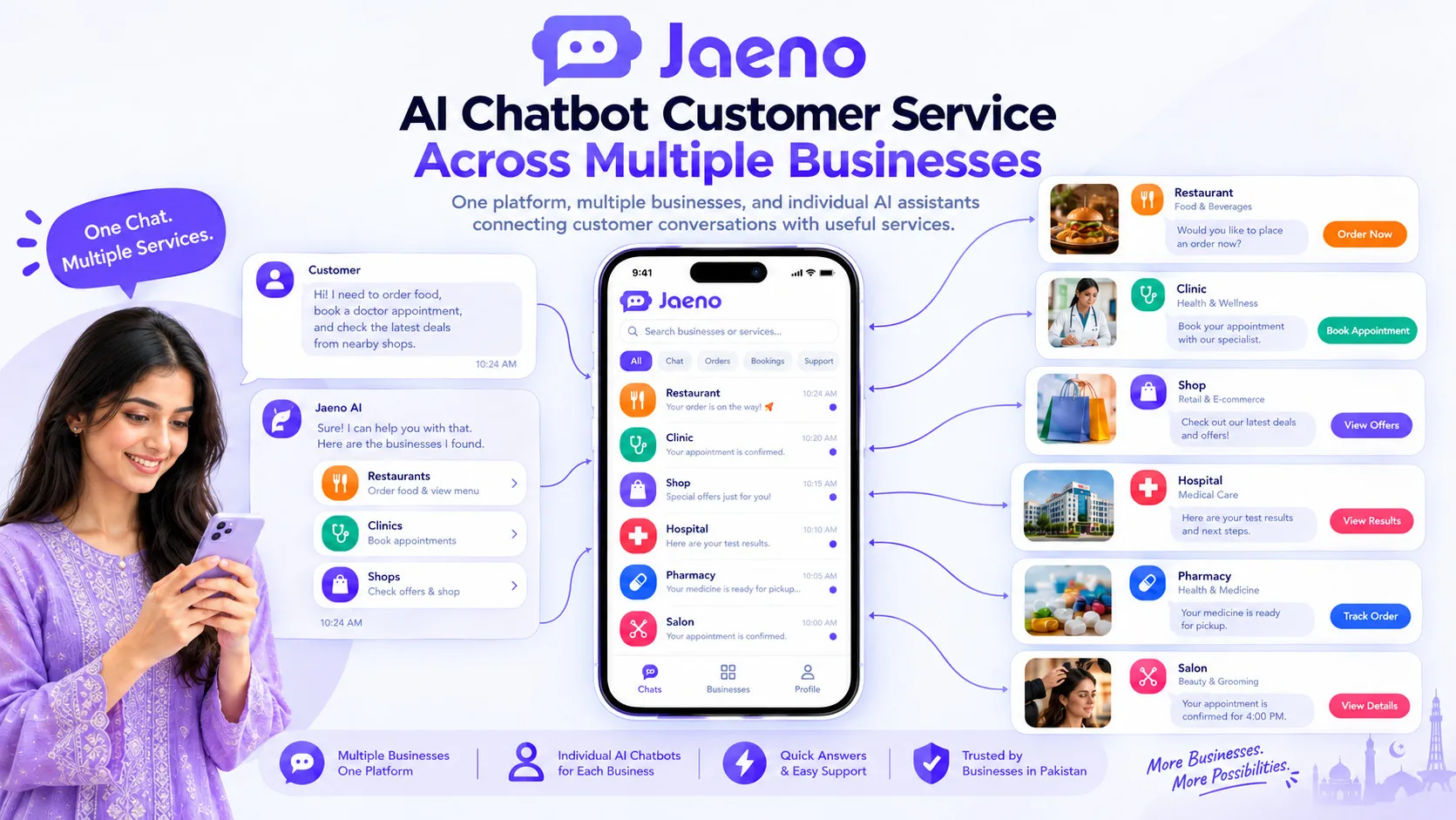
How to Choose a Customer Service Chatbot for Your Business
A customer service chatbot helps businesses answer common questions, guide customers, and handle routine requests without requiring staff to respond to every message manually. The right solution can also connect conversations to practical actions, such as taking restaurant orders, scheduling clinic appointments, or answering product enquiries. For businesses in Pakistan, the key is to choose a chatbot that fits daily operations, supports accurate business information, and passes complex requests to a person when necessary. The main options, essential features, likely costs, and how Jaeno fits into the decision.
What Is a Customer Service Chatbot, and How Does It Work?
A customer service chatbot is software that communicates with customers through a chat interface. Depending on its capabilities, it can answer frequently asked questions, retrieve business information, collect details, and guide customers through tasks such as placing an order or requesting an appointment.
Traditional chatbots follow predefined rules. More advanced AI-powered systems interpret natural-language questions and use approved business information to generate relevant responses. Some also connect to tools or business workflows to complete specific actions.
For example, a restaurant chatbot might answer questions about menu items, share prices, explain opening hours, and help a customer place an order. A clinic chatbot could provide information about departments and collect an appointment request. However, a clinic should route medical concerns to a qualified professional rather than let a chatbot diagnose or recommend treatment.
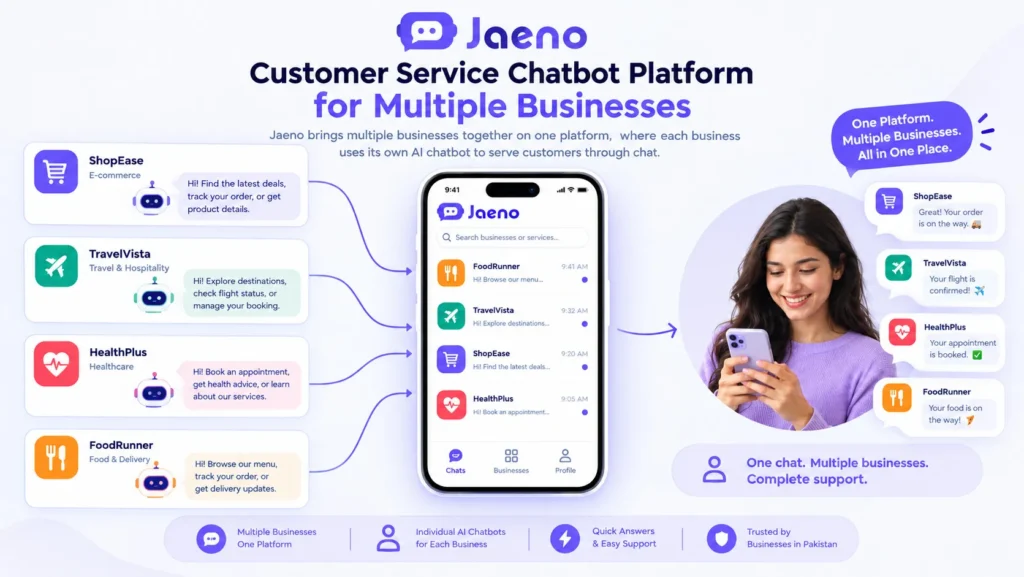
What can a chatbot handle?
Common uses include:
- Customer enquiries: Answer questions about services, prices, opening hours, location, and availability.
- Orders: Share product or menu information and guide customers through ordering.
- Appointments: Collect booking details and support appointment requests.
- Lead generation: Ask relevant questions and record contact details with appropriate consent.
- Customer support: Explain routine processes and direct complicated issues to the right person.
- Reviews and follow-ups: Invite feedback through an appropriate, clearly defined workflow.
Expert insight: Start with a task that happens frequently and follows a clear process. Automating ten repeated questions accurately is usually more useful than launching a chatbot that attempts to answer every possible question.
Why Should Pakistani Businesses Use an AI Chatbot for Customer Service?
An AI chatbot for customer service can help a business respond more consistently, reduce repetitive work, and make routine information available outside normal working hours. Its value depends on whether it solves real customer problems, not simply whether it uses AI.
Consider a pharmacy in Lahore that receives repeated enquiries about business hours, product availability, delivery areas, and prescription requirements. Staff may have to interrupt other tasks to answer each question. A well-configured chatbot can handle approved general information and direct customers to a pharmacist when a request requires professional judgement.
Similarly, a café in Karachi could use a chatbot to answer menu questions and guide customers towards an order. A clothing shop in Islamabad might provide product details, sizing information, and stock enquiries. In each case, the system should use current business information rather than guess.
Salesforce’s State of Service research, published in November 2025, surveyed 6,500 service professionals globally. Respondents estimated that AI handled 30% of service cases in 2025 and projected that AI would handle 50% by 2027. These are global survey findings and projections, not measured results for Pakistani small businesses. Read the report.
Benefits and limitations
| Potential benefit | What the business needs to get right |
| Faster routine replies | Keep answers accurate and business information current |
| Fewer repetitive staff tasks | Identify which tasks are safe to automate |
| Support beyond business hours | Explain when human staff will respond |
| More organized enquiries | Capture and route customer details appropriately |
| Easier order or booking journeys | Connect the chatbot to a reliable process and confirm actions |
Expert insight: For a small business, consistency is often a better starting goal than replacing staff. A chatbot should remove repetitive tasks while preserving human attention for complaints, sensitive questions, and unusual requests.
Which Features Should You Look for in a Customer Service AI Chatbot Solution?
A customer service AI chatbot solution should do more than produce fluent replies. It should use reliable business information, protect customer data, handle tasks within its permissions, and make it easy to involve a human when necessary.
Before choosing a platform, review these features.
1. Business-specific answers
The chatbot should use approved information about your products, services, prices, policies, location, and opening hours. Ask how you can update this information and how the system behaves when it does not know an answer.
2. Real business actions
If your main goal is to increase orders or appointments, look for workflows that support those tasks. A chatbot that only answers questions may not meet your needs. Check whether the platform can collect booking details, confirm an order, or connect to the systems your business already uses.
3. Human handoff
Customers should have a clear way to reach staff. The system should pass relevant conversation details to the person handling the request, where the platform supports that function.
4. Privacy and access controls
Review what customer data the platform collects, where it is stored, who can access it, how long it is retained, and whether you can delete it. For clinics and pharmacies, apply stricter controls to health-related information and avoid placing sensitive details in an unapproved chatbot workflow.
5. Language and mobile usability
Your customers may prefer English, Urdu, or Roman Urdu. Test the actual language combinations your customers use, including local expressions and spelling variations. Do not assume a platform supports every language equally well just because it uses AI.
6. Reporting and maintenance
Look for useful reporting, such as unanswered questions, conversation outcomes, booking requests, and common customer issues. These insights help you improve the information and workflows over time.
Expert insight: Ask a vendor to demonstrate your real scenarios not just a polished sample conversation. Test an outdated price, an unavailable appointment, an unclear question, and a request that must go to a human.
Customer Service Chatbot vs. Live Chat vs. AI Agent: What’s the Difference?
These options solve related but different problems. A rules-based chatbot handles predefined interactions, live chat lets staff respond directly, and an AI agent may interpret requests and perform permitted actions through connected tools.
| Option | Best suited for | Main limitation |
| Rules-based chatbot | FAQs and predictable decision paths | Struggles with requests outside its configured rules |
| Live chat | Personal support and complex cases | Requires staff availability |
| AI chatbot | Natural-language questions and routine support | Can misunderstand requests or provide incorrect answers |
| AI agent with connected workflows | Tasks such as collecting details, initiating bookings, or progressing orders | Requires reliable integrations, permissions, monitoring, and escalation |
An AI chatbot and an AI agent are not automatically the same thing. Some chatbots only provide information, while agent-style systems can use tools to complete defined actions. Always confirm which capabilities a vendor actually offers.
For a small café, a simple FAQ chatbot may be enough. However, a multi-location clinic or a growing retailer may need booking workflows, staff routing, and better reporting. The right choice depends on operational complexity rather than the latest terminology.
Expert insight: Pay for the capability your business will use. If you only need opening hours and location answers, a complex automation setup may add cost without delivering meaningful value.
How Much Does a Customer Service Chatbot Cost in Pakistan?
The cost depends on the platform, conversation volume, required integrations, setup work, and level of human support. There is no single reliable price for every Pakistani business, so request a current quote or published pricing from each provider.
Some tools offer free plans or trials with limits. Others charge recurring subscription fees, usage-based fees, implementation costs, or additional amounts for integrations and premium features. A free plan may be enough for a basic proof of concept, but it may not include the business actions you need.
Before committing, ask vendors to explain:
- Monthly subscription and usage charges.
- Setup, training, and integration fees.
- Limits on conversations, users, or connected systems.
- Charges for human handoff or additional features.
- Data export, cancellation, and account deletion options.
- What support is available when the chatbot fails.
A simple way to assess value
Estimate the time your team currently spends on repetitive enquiries each week. Then identify which portion a chatbot could realistically handle without compromising service quality.
For instance, a business might record the number of routine questions it receives, the average handling time, and the number that need staff intervention. These are figures you can measure internally; do not assume the chatbot will eliminate all of that work.
Expert insight: Compare the total cost of running the system with the value of the tasks it actually completes. A low subscription price is not a bargain if staff must constantly correct answers or finish every workflow manually.
How Does Jaeno Fit Into Customer Service Automation?
Jaeno positions itself as a platform that connects business conversations with actions such as orders and bookings. Its official website describes AI-assisted customer interactions, menu and cart ordering, appointment booking, loyalty and referral rewards, and automated customer reviews. Check the current product details to confirm which features are available for your intended setup.
For businesses that need more than a basic question-and-answer bot, this approach may be relevant because it connects customer conversations with practical business processes.
Potential use cases include:
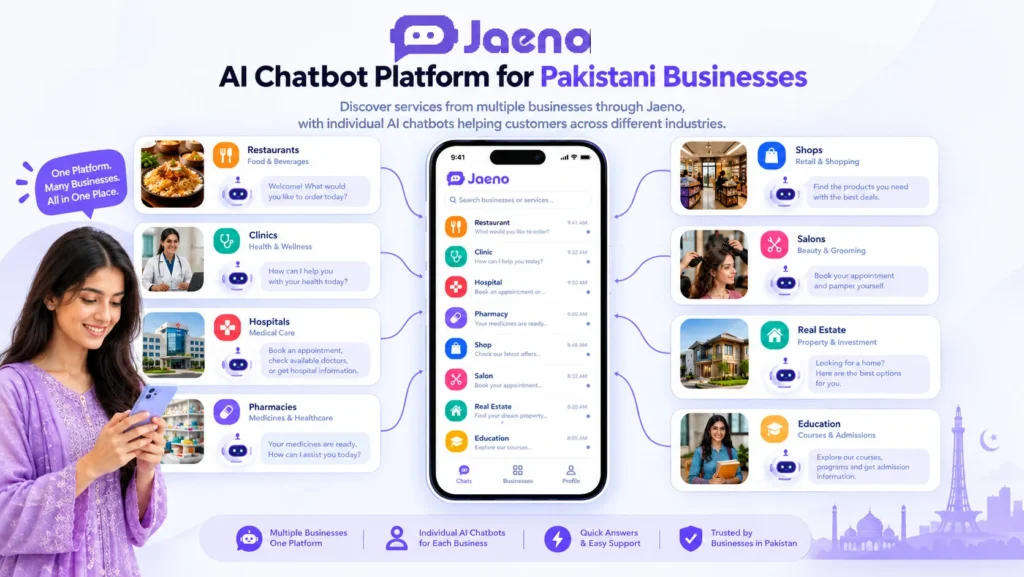
- Restaurants and cafés: Present menu information and guide customers through ordering.
- Clinics and salons: Provide service information and support appointment requests.
- Shops and local markets: Answer product enquiries and help customers find relevant information.
- Service businesses: Capture enquiries and guide customers towards the next step.
Jaeno is not automatically the right option for every organization. Businesses that need a custom internal workflow, complex enterprise integrations, or specialized compliance controls should confirm those requirements directly with the provider before choosing a platform.
You can explore the Jaeno website and its business offering. Ask for a demonstration using your own customer questions, business information, and booking or ordering process.
Expert insight: Judge Jaeno—or any alternative—by the complete customer journey. Can a customer get a correct answer, take the intended next step, receive confirmation, and reach a person when needed? That is a more useful test than the chatbot’s ability to hold a conversation.
How Can You Set Up a Customer Service Chatbot?
A small, focused rollout helps you identify problems before customers depend on the system. Begin with one business goal, test the chatbot against real enquiries, and expand only after the workflow behaves reliably.
- Choose one use case. Start with FAQs, order enquiries, or appointment requests.
- Prepare approved information. Gather current prices, service descriptions, opening hours, policies, and escalation contacts.
- Define its limits. Specify which questions it may answer and which requests require a staff member.
- Configure the workflow. Connect ordering, booking, or lead-capture tools only where the chosen platform supports them.
- Test realistic scenarios. Include misspellings, incomplete questions, unavailable items, changed schedules, and requests for a human.
- Launch with monitoring. Review incorrect answers, abandoned conversations, successful actions, and customer feedback.
- Improve regularly. Update business information and adjust the workflow when policies, prices, or services change.
For example, a clinic could initially automate opening hours, location details, and appointment requests. After reviewing the results, it might expand the system to provide approved information about departments. Medical advice and urgent concerns should still follow the clinic’s established professional procedures.
Expert insight: Keep a written list of situations the chatbot must not handle independently. Clear boundaries, reliable escalation, and regular checks are essential parts of a useful customer service system.
Conclusion
A good customer service chatbot should make it easier for customers to get accurate information and complete routine tasks—not simply generate replies. Start by identifying repeated enquiries, then compare business-specific answers, workflow capabilities, human handoff, privacy controls, language support, and total cost. Test the solution with realistic scenarios before relying on it in daily operations. For Pakistani restaurants, clinics, cafés, pharmacies, and shops looking to connect conversations with orders or bookings, explore Jaeno and request a demonstration based on your business requirements.
Frequently Asked Questions
Can a customer service chatbot work 24/7?
A chatbot can provide automated responses outside normal working hours when the platform and its infrastructure are available. However, this does not mean every request will be resolved immediately. Complex issues may need staff follow-up, and businesses should explain expected response times for cases that require human assistance.
Is an AI chatbot suitable for a small business?
Yes, if the business receives repeat questions or handles routine requests that follow a clear process. A small shop, café, or salon might start with opening hours, service details, product enquiries, or booking requests. However, a business with very few enquiries may not need a paid platform or complex automation.
Can a chatbot understand Urdu and Roman Urdu?
Language support varies by platform, model, and configuration. Test Urdu script, Roman Urdu, mixed English and Urdu, local expressions, and common spelling variations before launch. Also check whether the chatbot can respond naturally and accurately, rather than merely recognizing a few familiar words.
Will a chatbot replace customer service staff?
A chatbot can handle some routine questions and structured tasks, but it should not replace human judgement in every situation. Staff remain important for complaints, sensitive matters, exceptions, and decisions that require professional expertise. The most useful setup defines what the chatbot can do and when it must transfer the conversation to a person.
What should I prepare before requesting a chatbot demo?
Prepare your most common customer questions, current prices, service details, opening hours, policies, and the steps customers take to place an order or request an appointment. Include examples of questions that need human support. This gives you a practical way to compare vendors against your actual business needs.
About the Author
Written and reviewed by the Jaeno team.
Jaeno provides an AI-powered business conversation platform designed to connect customer enquiries with business services, including ordering and appointment booking. Its content helps businesses evaluate customer communication and automation options.