

AI Customer Services: Benefits, Uses and Best Practices
Customers expect quick answers, helpful recommendations, and support whenever they need it. For businesses in Pakistan, that often means responding to questions on websites, WhatsApp, social media, and other digital channels without making customers wait for a human representative.
This is where AI customer services can make a practical difference.
Modern AI can understand customer questions, provide relevant answers, recommend products, collect information, book appointments, assist with orders, and transfer complex conversations to human staff. Instead of replacing customer service teams, businesses can use AI to handle repetitive conversations while employees focus on customers who need personal attention.
For businesses in Lahore, Karachi, Islamabad, and across Pakistan, this approach can also help reduce missed enquirers and improve response times as customer communication becomes increasingly digital.
What Are AI Customer Services?
AI customer services use artificial intelligence to automate and improve interactions between a business and its customers.
Unlike traditional automated replies that follow rigid scripts, modern AI customer service systems can understand natural language and respond according to the context of a conversation. They can use information from a company’s FAQs, product catalogue, policies, services, and other approved business information.
Common technologies include:
- AI chatbots
- Conversational AI
- Generative AI
- AI virtual assistants
- Natural language processing (NLP)
- Machine learning
- AI voice agents
- Automated customer support
- Knowledge-base systems
- CRM integrations
For example, instead of sending a customer a generic message such as “Our team will contact you shortly,” an AI assistant can answer a specific question about pricing, availability, delivery, or booking.
IBM describes AI in customer service as a combination of AI and automation designed to streamline support, assist customers quickly, and personalize interactions.
Why Are Businesses Adopting AI Customer Services?
Customer expectations have changed. People increasingly expect businesses to respond quickly, particularly when they contact a company through chat or messaging platforms.
Salesforce’s 2025 State of Service research found that service professionals estimated AI was already handling around 30% of customer service cases, with that figure expected to reach 50% by 2027.
The shift is not simply about reducing workload. Businesses are also exploring AI to improve accessibility, consistency, personalization, and customer experience.
For a growing Pakistani business, the benefits can include:
- Faster responses – Customers receive answers without waiting for office hours.
- 24/7 availability – AI can handle routine questions outside normal working hours.
- Lower repetitive workload – Staff spend less time answering the same FAQs.
- Consistent information – Customers receive answers based on approved business information.
- Lead qualification – AI can ask questions and identify customers who need sales follow-up.
- Better scalability – Businesses can handle more conversations without increasing support staff at the same rate.
How AI Customer Support Works
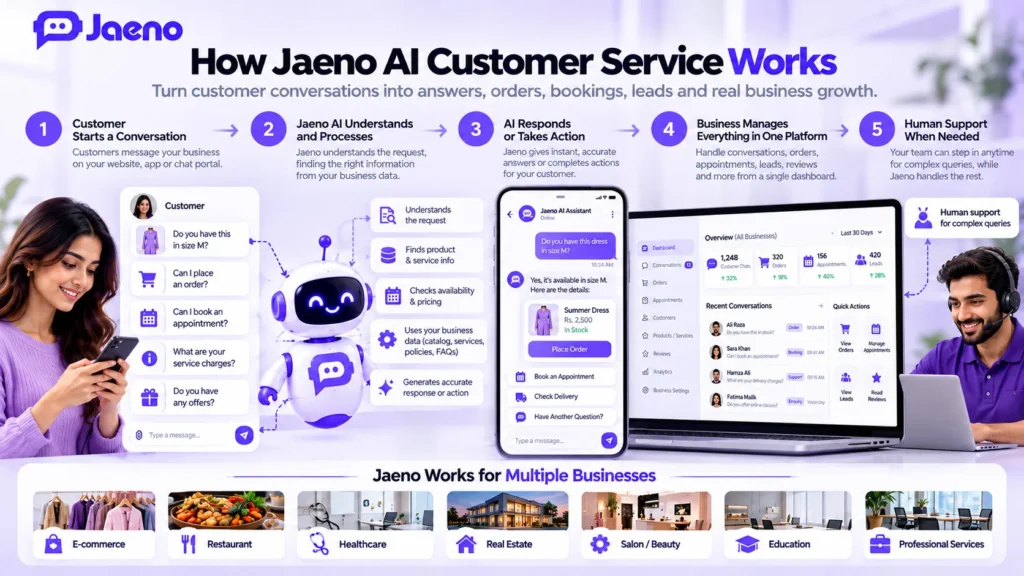
A typical AI customer support system follows a straightforward process.
1. The customer starts a conversation
A customer may ask:
“Do you deliver to DHA Lahore?”
Or:
“What is the price of your premium package?”
The AI identifies the customer’s intent rather than simply matching a predefined keyword.
2. AI understands the request
Natural language processing helps the system interpret the question and conversation context.
For example, if a customer first asks about a product and then says, “What about the black one?”, the AI can use the previous message to understand what “the black one” refers to.
3. AI retrieves relevant information
The system can use an approved knowledge base containing information such as:
- Products and services
- Prices
- Business hours
- Delivery areas
- Return policies
- Appointment availability
- FAQs
- Company policies
4. AI responds or takes action
Depending on the setup, the assistant can answer the question, collect customer details, recommend an option, book an appointment, or initiate another business workflow.
5. A human takes over when necessary
Good AI customer services should include human escalation.
If the customer has a complaint, asks an unusual question, or needs a decision that the AI cannot confidently make, the conversation can move to a human representative.
This combination gives businesses automation without forcing every customer into an AI-only experience.
AI Customer Services for Pakistani Businesses
Pakistan has a particularly strong opportunity for conversational customer service because businesses frequently communicate with customers through messaging platforms.
Local AI providers are already developing solutions around Urdu, English, and Roman Urdu conversations, particularly for WhatsApp-based enquiries and lead generation.
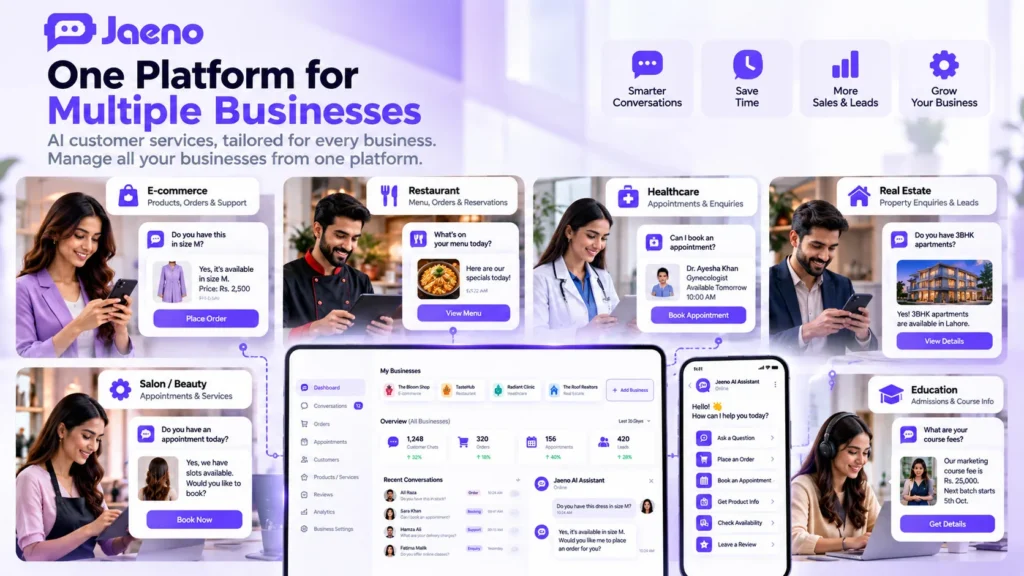
For businesses in Lahore, Karachi, and Islamabad, practical use cases include:
E-commerce
AI can answer questions about:
- Product prices
- Sizes and colours
- Delivery charges
- Order status
- Return policies
- Product recommendations
Real Estate
Property businesses can use AI to qualify enquiries, collect budgets and locations, share project information, and arrange appointments.
Education
Schools, universities, academies, and training centres can automate questions about admissions, fees, schedules, courses, and registration.
Healthcare and Clinics
AI assistants can handle general administrative enquiries, appointment requests, opening hours, and service information while escalating sensitive matters to appropriate staff.
Restaurants and Food Businesses
An AI assistant can answer menu questions, provide opening hours, collect takeaway or delivery requests, and direct customers toward ordering channels.
Professional Services
Law firms, agencies, consultants, salons, and other service businesses can use AI to answer FAQs, collect enquiry details, and schedule consultations.
AI Customer Services vs Traditional Customer Support
AI does not need to replace traditional customer support. In many businesses, the two work better together.
| Area | Traditional Support | AI Customer Services |
| Availability | Usually business hours | Can operate 24/7 |
| Repetitive FAQs | Staff handle manually | AI can automate |
| Response speed | Depends on workload | Usually immediate |
| Complex issues | Strong | Human escalation recommended |
| Personal interaction | High | Depends on implementation |
| Scalability | Requires more staff | Can handle many simultaneous conversations |
| Consistency | Depends on employee | Can use centralized knowledge |
The important point is that AI should support the customer service team rather than blindly automate every interaction.
Key Features to Look for in an AI Customer Service Platform
If you are comparing AI customer service software, focus on capabilities rather than marketing claims.
Look for:
- Natural language understanding for conversational questions
- Knowledge-base integration so answers reflect your business
- Human handoff for complex conversations
- Conversation history for better context
- Multi-channel support across relevant customer touchpoints
- Lead qualification for sales enquiries
- Appointment booking
- Order and enquiry management
- Analytics and conversation reporting
- Multilingual capabilities, particularly Urdu and English for Pakistan
- Security and privacy controls
- Easy business configuration without requiring extensive technical knowledge
A strong system should also make it easy for a business to update its information. If your prices, policies, products, or opening hours change, the AI should not continue relying on outdated information.
How Jaeno Can Help Businesses
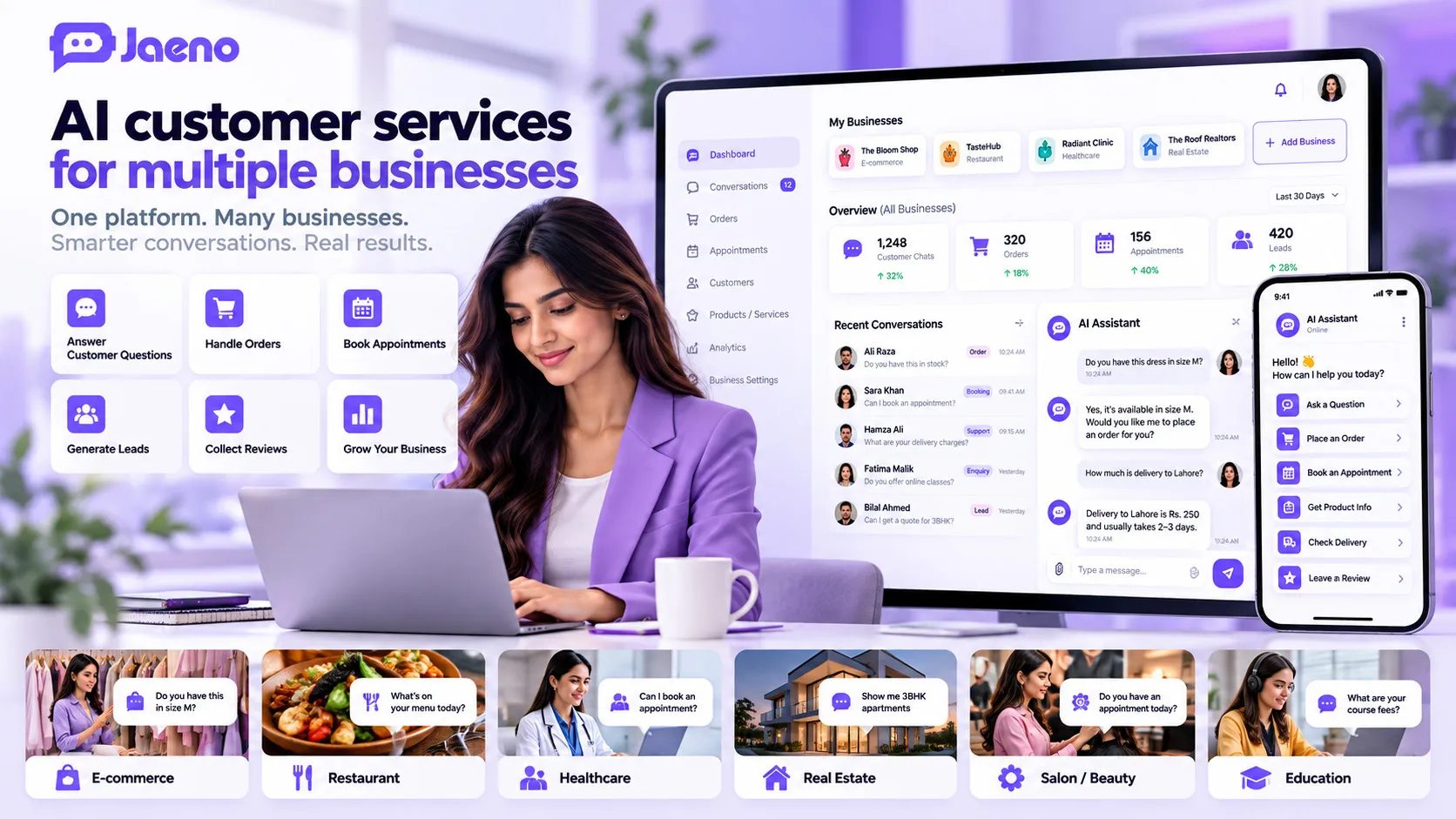
Jaeno is designed around the idea that businesses should be able to communicate with customers through an AI-powered business assistant.
Instead of making customers navigate complicated systems, businesses can use conversational interactions to answer questions and support common customer journeys.
For example, an AI assistant can help customers:
- Ask a question
- Explore products or services
- Place an order
- Book an appointment
- Request information
- Leave a review
- Get support
For Pakistani businesses, this approach can be particularly useful when customers expect fast, conversational communication.
Businesses can learn more about Jaeno and its AI-powered business communication platform at Jaeno.ai.
Best Practices for Implementing AI Customer Services
Simply installing an AI chatbot does not guarantee better customer service. The quality of the underlying information and workflow matters just as much.
Follow these practices:
Start with repetitive questions
Identify the questions your team answers most frequently. These make strong candidates for automation.
Train AI with accurate information
Give the system reliable business information rather than expecting it to guess.
Define escalation rules
Clearly determine when a conversation should move from AI to a human.
Keep the tone consistent
Your AI assistant should reflect your brand’s communication style while remaining clear and professional.
Monitor conversations
Review conversations regularly to discover incorrect answers, unanswered questions, and new customer needs.
Measure meaningful metrics
Track metrics such as:
- Response time
- Resolution rate
- Human escalation rate
- Customer satisfaction
- Lead conversion
- Number of automated conversations
- Frequently asked questions
These measurements help businesses determine whether AI is actually improving the customer experience.
What Is the Future of AI Customer Services?
The next stage of AI customer service is moving beyond simple question-and-answer chatbots.
AI agents are increasingly capable of understanding context, retrieving information, and taking actions within business workflows. Salesforce reported significant growth in customer-service conversations handled by AI agents during the first half of 2025.
This points toward a model where an AI assistant does more than answer “What are your opening hours?”
It may eventually handle a complete customer journey:
Question → Recommendation → Booking → Confirmation → Follow-up
However, human involvement will remain important for sensitive, unusual, high-value, or emotionally complex situations.
The strongest approach is therefore not “AI instead of humans.” It is AI for scalable routine interactions, humans for situations that require judgment, empathy, and accountability.
Conclusion
AI customer services are changing how businesses respond to customers by making support faster, more scalable, and available beyond traditional working hours.
For businesses in Lahore, Karachi, Islamabad, and across Pakistan, conversational AI can help manage repetitive enquiries while giving human teams more time for valuable customer interactions.
The best results come from combining accurate business information, thoughtful automation, human escalation, and continuous monitoring.
If you want to explore how an AI-powered business assistant can handle customer questions, orders, bookings, and support, visit Jaeno and explore the platform at Jaeno.ai.
Frequently Asked Questions
What are AI customer services?
AI customer services use artificial intelligence to answer customer questions, provide support, automate repetitive tasks, and assist with customer interactions. Modern systems can understand natural language and use business-specific information to provide relevant responses.
Can AI completely replace customer service agents?
Not in every situation. AI can handle many repetitive and straightforward enquiries, but human representatives remain important for complex complaints, sensitive issues, unusual requests, and situations requiring judgment.
Is AI customer support suitable for small businesses?
Yes. Small businesses can use AI customer support to answer FAQs, capture leads, provide information after business hours, and reduce repetitive workloads without immediately building a large support team.
Can AI customer services work in Pakistan?
Yes. Businesses in Pakistan can use AI for website and messaging-based customer interactions. Multilingual systems can also support communication patterns involving English, Urdu, and Roman Urdu. Local AI providers are already offering these capabilities to Pakistani businesses.
What is the difference between an AI chatbot and AI customer service?
An AI chatbot is usually one component of a broader customer service system. AI customer service can include chatbots, AI agents, knowledge bases, automated workflows, CRM integrations, analytics, and human escalation.
How should a business start using AI customer services?
Start by identifying repetitive customer questions and high-volume communication channels. Then choose an AI platform that can use your business information, escalate complex conversations to staff, and provide analytics so you can measure results.
About the Author
Jaeno AI Editorial Team creates practical resources about artificial intelligence, conversational commerce, customer experience, and business automation. Our content focuses on helping businesses understand how emerging AI technologies can be applied to real-world customer communication and day-to-day operations.