

Custom AI Agent Integration: Complete Guide for Pakistan in 2026
Businesses across Pakistan are exploring artificial intelligence to improve daily operations. However, building an AI agent is only the beginning. The real value comes when that agent connects with customers, business information, and everyday workflows.
Custom AI agent integration helps organizations connect their AI systems with existing applications and communication platforms. From retail stores in Lahore to technology startups in Karachi, businesses can use these connections to support customers, organize requests, and simplify routine tasks.
Custom AI agent integration is the process of connecting a business-specific AI agent to software, data sources, APIs, and customer communication platforms. It enables authorized tasks such as answering product questions, checking availability, creating bookings, and managing orders. Successful integration requires reliable business data, secure permissions, compatible systems, testing, and human oversight.
Key Takeaways
- Custom AI agents use business-specific information and approved tools to complete tasks.
- Integration connects AI capabilities with customer communication and operational systems.
- Businesses can develop their own agents or use suitable third-party frameworks.
- Security, accurate information, and human escalation are essential.
- Jaeno provides a business communication platform where registered businesses can bring their own AI agents.
What Is Custom AI Agent Integration?
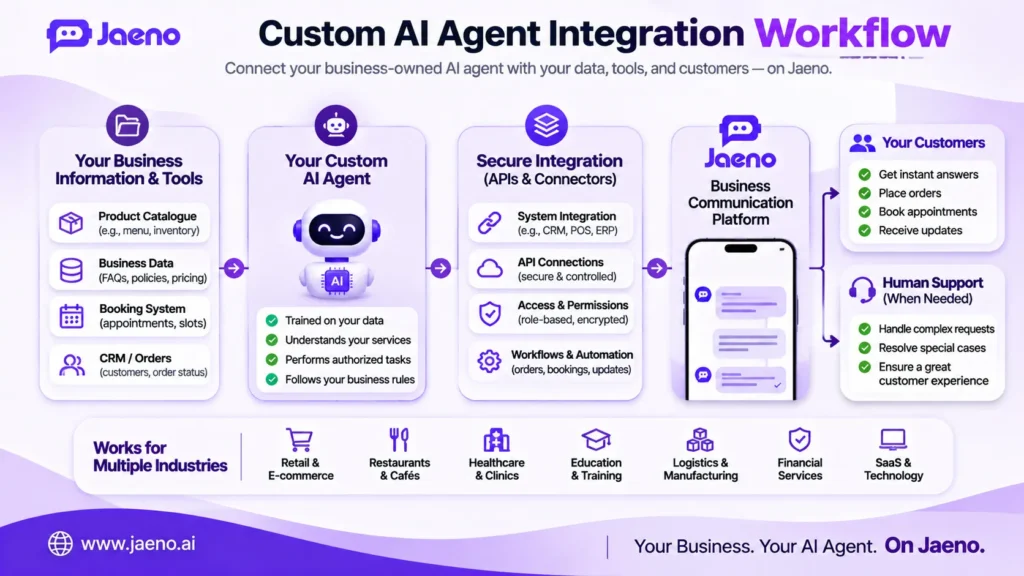
Custom AI agent integration connects an independently developed AI agent with systems that help it perform useful business tasks.
An AI agent combines a language model, instructions, business knowledge, and authorized actions. Integration allows it to access the information and tools required for those actions.
For example, a furniture store may develop an agent that understands its product catalogue. The agent could answer customer questions and recommend relevant items.
However, without an approved communication channel, customers may have no convenient way to interact with it.
Integration connects these separate components into a usable business experience.
Custom AI Agents vs Traditional Chatbots
Traditional chatbots often rely on predefined conversation paths.
Custom AI agents can interpret more flexible requests, retrieve approved information, and interact with connected applications.
The distinction is practical:
| Capability | Traditional Chatbot | Custom AI Agent |
| Standard FAQs | Supported | Supported |
| Flexible language understanding | Usually limited | Model-dependent |
| Business knowledge retrieval | Requires configuration | Requires configuration |
| Tool-based actions | Requires integrations | Supported when configured |
| Human escalation | Can be configured | Can be configured |
Neither approach guarantees accuracy.
A simple chatbot with reliable information may outperform a poorly configured AI agent.
Therefore, businesses should focus on successful outcomes rather than technical complexity.
How Does Custom AI Agent Integration Work?
Custom AI agent integration typically connects five important components.
- AI model: Interprets messages and generates responses.
- Business knowledge: Supplies approved products, policies, prices, and service information.
- Integration layer: Connects APIs, calendars, databases, and other permitted tools.
- Communication platform: Allows customers to interact with the business.
- Monitoring and security: Tracks failures, permissions, and performance.
Consider a customer asking whether a restaurant has a table available tomorrow.
The AI agent interprets the request and checks an authorized reservation system. It then presents available times.
After customer confirmation, the connected system records the booking.
Importantly, the agent should never confirm an appointment that the booking system has not accepted.
Custom AI Agent Development and Frameworks
Businesses can develop agents using different tools and architectures.
Common technologies include Python, JavaScript, language-model APIs, retrieval-augmented generation, and agent orchestration frameworks.
Frameworks such as LangChain, LangGraph, and Microsoft AutoGen provide different approaches to developing agent applications.
However, a framework is not a complete business communication platform.
Developers must still handle authentication, error recovery, data access, deployment, and customer-facing interactions.
Before choosing a custom AI agent builder, assess your team’s technical skills and the complexity of the intended workflow.
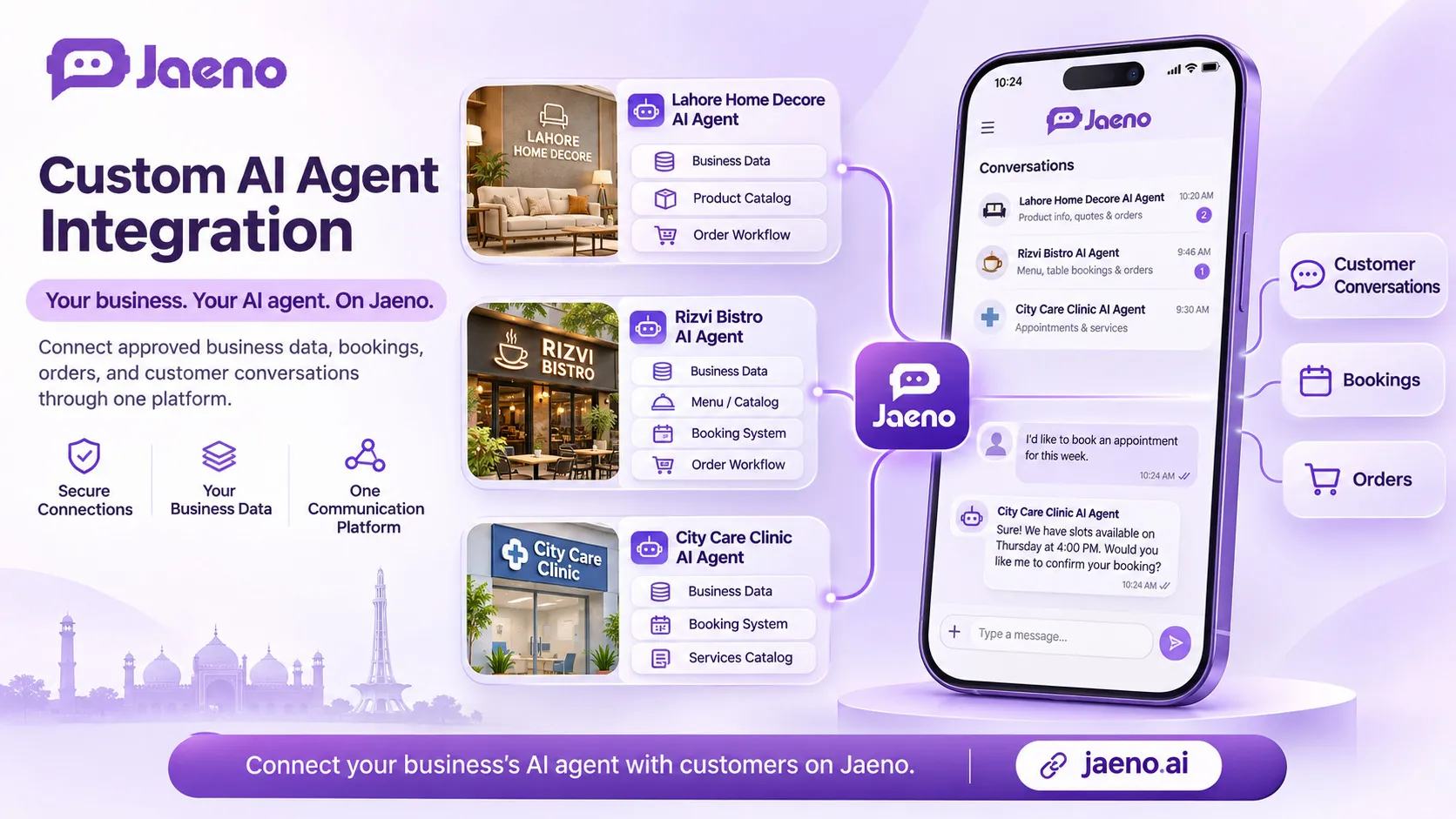
Connecting Business-Owned AI Agents With Jaeno
Jaeno is a standalone business communication platform.
Jaeno is not an AI agent builder, model-hosting service, or an AI agent itself.
Instead, businesses can bring their own AI agents to Jaeno, where customers interact with registered businesses through chat.
For example, Lahore Home Decor could connect its independently developed agent to support product enquiries and showroom booking requests.
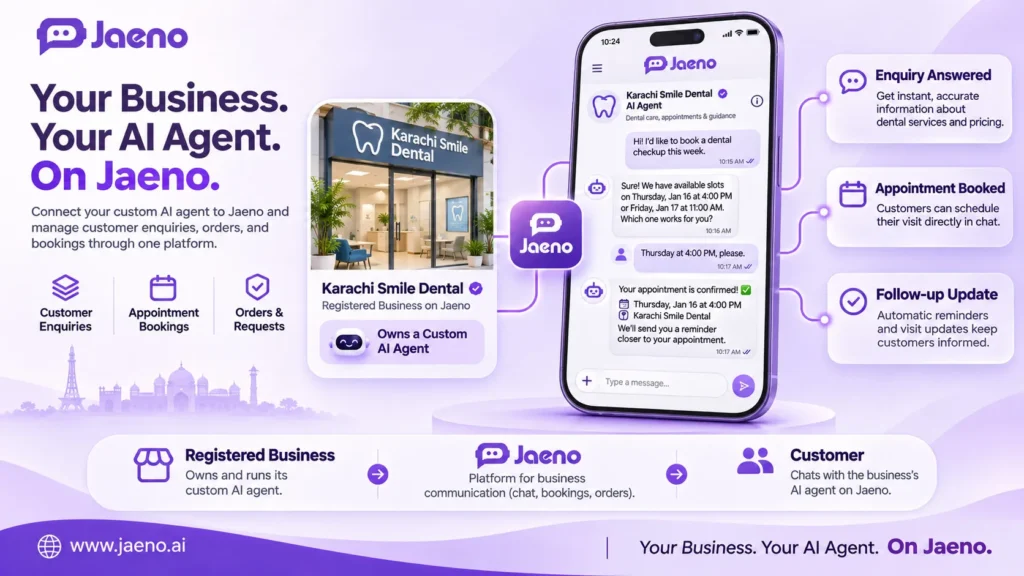
The business owns its AI agent and provides its business information. Jaeno serves as the customer communication environment.
The platform describes in-chat ordering, appointment booking, loyalty features, and reviews. Integration requirements and supported connections should be verified before implementation.
Why Do Pakistani Businesses Need Custom AI Integration?
Custom AI agent integration is useful when organizations want automation adapted to their services, customers, and existing workflows.
A generic assistant may answer broad questions. However, a business-specific agent can use approved operational information.
For Pakistani companies, language and location also matter.
Customers may communicate in English, Urdu, or Roman Urdu. Consequently, AI agents should be tested using realistic local expressions.
Consider several applications.
Retail and E-commerce
Online stores can connect agents to approved product catalogues, order information, and appointment workflows.
For example, a customer in Karachi could request available products and confirm an order through a supported business chat.
Restaurants and Cafés
Restaurants can use their own agents to explain menus, support ordering, and handle reservations.
However, menu prices and availability must remain accurate.
SaaS and Technology Companies
Software businesses can connect agents with approved documentation, onboarding information, and support workflows.
Complex technical problems should remain accessible to qualified employees.
Financial Services and Insurance
Financial organizations can automate administrative enquiries and appointment scheduling.
Sensitive account requests, regulated advice, and financial decisions require stronger verification and oversight.
Healthcare Operations
Clinics can explore administrative scheduling and general service enquiries.
However, clinical advice and confidential patient information require appropriate safeguards.
Logistics and Manufacturing
Companies can connect agents to verified order-status systems and distributor information.
Nevertheless, agents must not invent shipment dates or inventory figures.
In every sector, the business remains responsible for its agent’s permissions and information.
How to Choose Custom AI Agent Integration Software
Selecting custom AI agent integration software requires evaluating functionality, reliability, and total operating costs.
Businesses should compare solutions against actual customer tasks.
Practical Integration Checklist
Before investing, review these requirements:
- Compatibility: Does the solution support the agent’s model and existing systems?
- API access: Can authorized tools exchange information securely?
- Business knowledge: Can staff update documents, prices, and policies?
- Permissions: Can administrators restrict sensitive actions?
- Language support: Has the agent been tested in Urdu and Roman Urdu?
- Human handoff: Can employees handle unresolved requests?
- Monitoring: Can the team review incorrect answers and failed actions?
- Cost: Are setup, model usage, integrations, and maintenance clearly priced?
According to the NIST AI Risk Management Framework, organizations should govern, map, measure, and manage AI-related risks.
These principles can guide system evaluation and ongoing oversight.
The OWASP GenAI Security Project also provides guidance concerning security risks in language-model and agentic applications.
Free vs Paid Custom AI Integration
Businesses searching for custom AI agent integration free options can explore open-source frameworks and development tools.
However, free software does not necessarily mean free deployment.
Hosting, model usage, APIs, security reviews, and maintenance may create additional costs.
Similarly, searches for custom AI agent integration online or download options often lead to different types of products.
Some provide downloadable development frameworks. Others offer cloud-based integrations or visual builders.
Choose based on the required workflow, not the download button or advertised price.
Custom AI Agent Integration Example: A Lahore Business
A practical custom AI agent integration example is a furniture retailer serving customers in Lahore.
Imagine Lahore Home Decor develops its own agent using approved product information.
The business wants customers to explore furniture, ask questions, and request showroom appointments.
Its implementation could follow five stages:
- Prepare an accurate furniture catalogue with current prices and descriptions.
- Develop an agent that understands customer product enquiries.
- Connect the agent to approved product and appointment systems.
- Explore a compatible communication platform such as Jaeno.
- Test product questions, booking requests, unavailable items, and human escalation.
For example, a customer might ask:
“Modern wooden dining table available hai?”
The business’s agent could retrieve matching products and provide verified details.
The customer might then request an appointment to inspect the furniture.
A connected booking workflow could present available showroom times and record a confirmed visit.
This is an illustrative scenario, not a verified customer implementation.
For performance measurement, suppose the system correctly resolves 85 of 100 eligible enquiries. Its verified resolution rate would be 85%.
Businesses should also measure incorrect answers, failed actions, operational costs, and customer satisfaction.
Conclusion: Connect Your Custom AI Agent With Jaeno
Custom AI agent integration helps businesses turn independently developed AI systems into practical customer experiences.
However, successful implementation depends on accurate information, secure connections, suitable communication tools, and human oversight.
For businesses in Lahore, Karachi, Islamabad, Rawalpindi, and across Pakistan, the starting point should be one measurable customer workflow.
If your business already has a custom AI agent, or plans to develop one, explore Jaeno.
Your business. Your AI agent. One communication platform.
Connect customers with your business through Jaeno and explore supported conversations, orders, and bookings.
Frequently Asked Questions
What is custom AI agent integration?
Custom AI agent integration connects an independently developed AI agent with business software, approved data sources, APIs, and communication platforms. It enables the agent to answer specific questions and perform authorized actions. Reliable integration requires accurate information, secure permissions, appropriate testing, and human oversight for sensitive situations.
Is custom AI agent integration software available for free?
Some frameworks and development tools are available under free or open-source licenses. However, hosting, model usage, API calls, and maintenance may involve charges. Businesses should compare total deployment costs rather than assuming that free software provides a complete, production-ready integration without additional expenses.
Can I integrate my existing AI agent with Jaeno?
Jaeno is designed around businesses bringing their own AI agents into a customer communication environment. However, technical compatibility depends on the agent’s architecture and supported integration methods. Businesses should confirm available APIs, onboarding requirements, permissions, and workflow compatibility with Jaeno before starting implementation.
What is the difference between custom AI agent development and integration?
Custom AI agent development involves designing and building the agent’s capabilities, knowledge access, and actions. Integration connects that agent with operational systems and customer-facing applications. Development determines what the agent can do, while integration determines which approved business systems and interactions it can access.
Which Pakistani businesses benefit from custom AI agents?
Retail stores, restaurants, SaaS companies, clinics, educational institutions, and logistics businesses may benefit from custom AI agents. Suitable tasks include product enquiries, administrative appointments, order information, and routine support. Each business should evaluate data protection, integration costs, operational complexity, and measurable customer outcomes before deployment.