

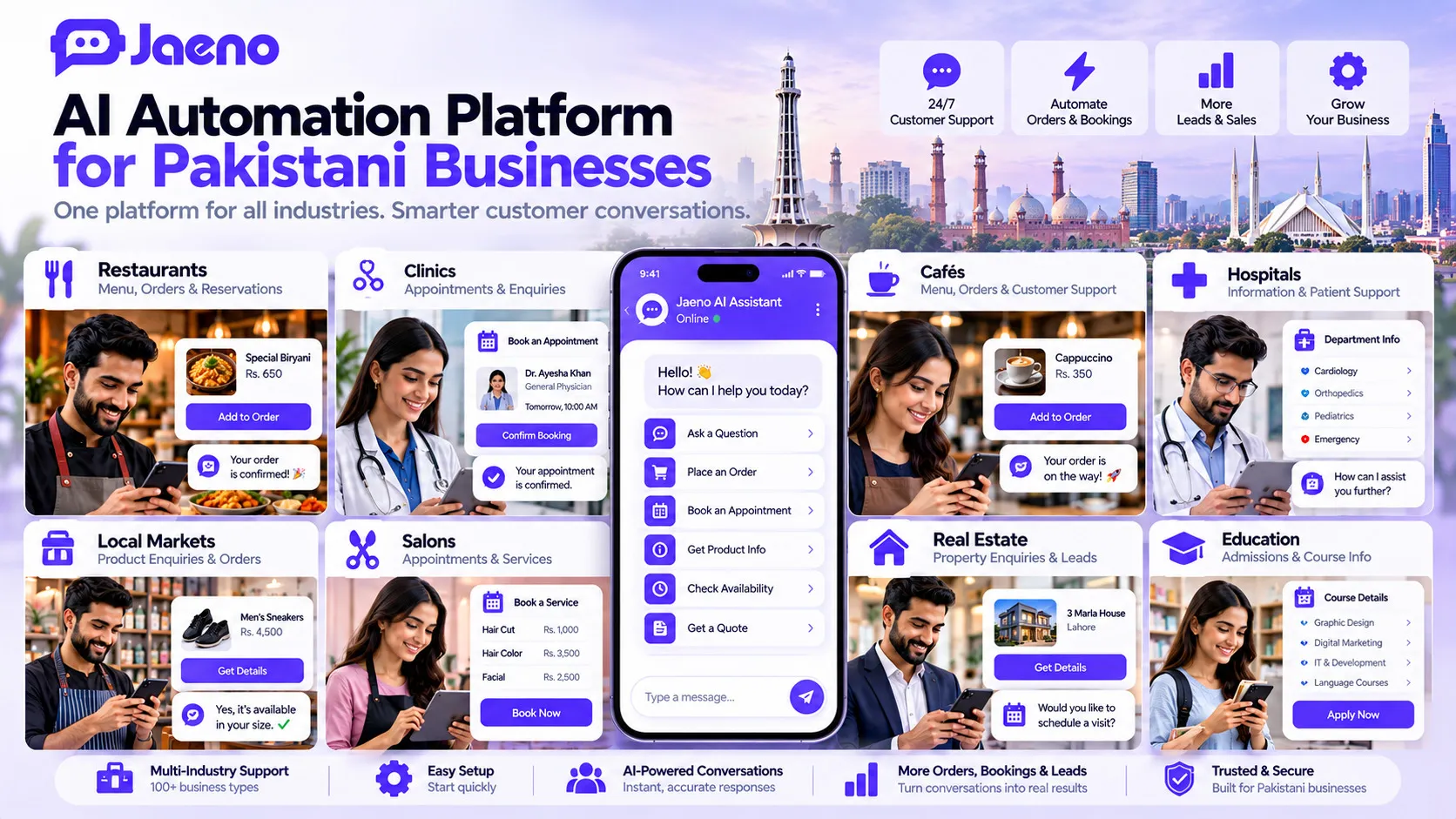
Customer Service Automation for Modern Businesses
What happens when a restaurant receives ten order questions while its staff are serving customers? What about a clinic handling appointment requests after closing time? Customer service automation can answer routine questions, guide customers, collect information, and move conversations toward an order or booking without making staff respond to every message manually.
For Pakistani restaurants, clinics, cafés, hospitals, local markets, and service businesses, the opportunity is practical: automate repetitive conversations while keeping people involved when a situation needs human judgment. In this guide, you’ll learn how customer service automation works, what to look for in an AI automation platform, how tools such as n8n fit into the market, and where Jaeno fits into the picture.
What Is Customer Service Automation?
Customer service automation means using software, AI, workflows, and business rules to handle parts of the customer-service journey automatically.
Traditional automation might send a predefined confirmation message. Modern AI systems can go further by understanding natural-language questions and using business information to provide context-aware responses.
For example, a café could receive:
“Is your breakfast menu available today, and can I order for pickup?”
Instead of requiring an employee to answer manually, an automated system could provide the relevant menu information, guide the customer toward available items, and support the ordering process.
What Can Customer Service Automation Handle?
Depending on the platform, automation can support:
- Frequently asked questions
- Product and service information
- Restaurant menus
- Online orders
- Appointment booking
- Booking confirmations
- Customer enquiries
- Lead collection
- Review requests
- Loyalty and referral workflows
- Order-status questions
- Customer follow-ups
- Human-agent escalation
Jaeno’s current platform specifically describes AI-powered customer service, in-chat ordering, appointment booking, loyalty and referral rewards, and automated review collection. It also states that businesses can give their AI agent a business-specific voice and use the platform across more than 100 industries.
Expert Insight: Automation works best when you automate a clearly defined customer journey, not simply when you add a chatbot to a website. Start with the repetitive questions and actions that already consume staff time.
Why Customer Service Automation Matters for Pakistani Businesses
A business does not need hundreds of employees to benefit from automation. In fact, smaller businesses can often feel the operational impact more quickly because the same person may handle customers, orders, appointments, and administrative tasks.
Consider a clinic in Lahore.
A receptionist might spend the morning answering questions such as:
- “What time does the doctor see patients?”
- “Is an appointment available tomorrow?”
- “How much is the consultation?”
- “Can I reschedule my appointment?”
- “Where is the clinic located?”
These questions are straightforward, but answering them repeatedly takes time.
With customer service automation, the business can provide approved information automatically and reserve staff time for situations that genuinely require human assistance.
Automation Can Help Different Business Types
| Business | Potential Automation |
| Restaurants | Menu questions, orders, reservations |
| Cafés | Menu information, pickup orders, promotions |
| Clinics | Appointments, schedules, general enquiries |
| Hospitals | General service information and enquiry routing |
| Local markets | Product questions, availability and order enquiries |
| Salons | Service information and appointments |
| Real estate | Property enquiries and lead collection |
| Academies | Course information and admissions enquiries |
The important distinction is that automation should handle appropriate tasks. A hospital, for example, should not rely on AI to make clinical decisions. It can use automation for administrative communication while directing medical questions to qualified professionals.
A Useful Industry Signal
Salesforce’s 2025 State of Service research surveyed 6,500 service professionals globally. Respondents estimated that AI handled 30% of service cases in 2025 and projected that AI could handle 50% by 2027. Those figures represent survey responses and expectations, not a guarantee for every business or country.
That distinction matters for Pakistani businesses. Global research can show the direction of the market, but each business should measure its own results.
Pro Tip: Before automating everything, record the questions your employees answer most frequently for 30 days. That list can become your first automation roadmap.
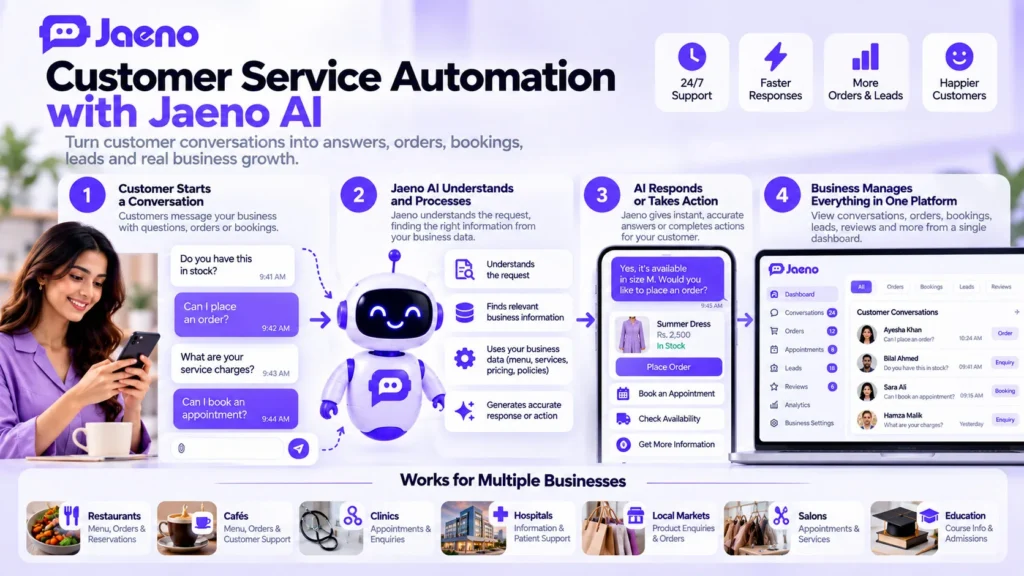
How AI Customer Service Automation Works
Modern customer service automation usually combines AI with business information and predefined actions.
Step 1: A Customer Starts a Conversation
The customer asks a question through a supported business chat experience.
For example:
Customer: “Can I book an appointment for tomorrow?”
The system identifies that the customer wants an appointment rather than a general information response.
Step 2: AI Understands the Request
Natural language processing helps the system interpret the customer’s intent.
The AI may identify:
- Appointment request
- Preferred date
- Service type
- Customer information
- Availability requirements
Step 3: The System Uses Business Information
An AI automation platform needs accurate business data to provide useful answers.
That information might include:
- Services
- Prices
- Opening hours
- Product catalogues
- Menus
- FAQs
- Appointment rules
- Policies
- Locations
Jaeno’s platform describes an AI agent that can answer questions and connect conversational interactions with menus, carts, calendars, orders, and bookings.
Step 4: AI Responds or Takes an Action
This is where modern automation differs from a basic FAQ bot.
The system may:
- Answer a question
- Display a product
- Add an item to a cart
- Start an order
- Book an appointment
- Confirm a request
- Collect customer information
Step 5: Human Support Handles Exceptions
A good system should not force every situation through automation.
If a customer has a complicated complaint, unusual request, or issue requiring human judgment, the workflow should provide a route to staff.
This human-in-the-loop approach also appears in modern workflow platforms. For example, n8n emphasizes human approvals, explicit business rules, monitoring, and traceable AI workflows.
Expert Insight: The goal isn’t to remove humans from customer service. The goal is to remove unnecessary repetitive work so employees can concentrate on conversations that need judgment, empathy, or accountability.
AI Automation Platform vs AI Workflow Automation Tools
When researching customer service automation, you’ll encounter several types of software.
Some platforms focus specifically on customer conversations. Others provide general workflow automation that connects applications, databases, APIs, AI models, and business processes.
What Is an AI Automation Platform?
An AI automation platform generally combines artificial intelligence with workflows or business actions.
A business might use it to:
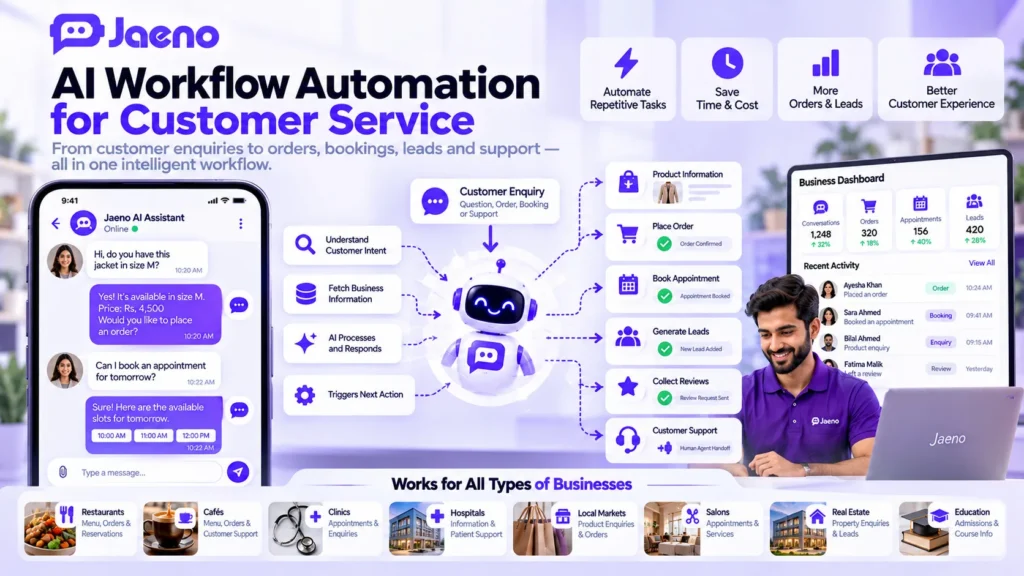
Customer message → AI understanding → Business data → Automated response → Order/booking → Confirmation
The platform becomes the layer connecting the customer conversation with the business process.
What Are AI Workflow Automation Tools?
AI workflow automation tools usually provide more flexible building blocks.
For example, n8n describes itself as a workflow automation tool with AI capabilities and supports integrations, AI agents, code, self-hosting, and visual workflows. Its current platform documentation also highlights more than 500 integrations.
These tools can be useful when a technical team wants to build custom workflows.
Jaeno vs General Workflow Automation
The distinction is important:
| Requirement | Jaeno | General Workflow Tool |
| Customer-facing business chat | Core use case | Depends on configuration |
| AI customer service | Core use case | Can be built |
| Orders and bookings | Built around business interactions | Usually requires workflow design |
| Custom API workflows | Depends on platform capabilities | Often a major strength |
| Technical customization | Platform-dependent | Often extensive |
| Human approval workflows | Depends on implementation | Common in advanced tools |
| Business-specific AI assistant | Core positioning | Usually needs configuration |
This doesn’t make one category universally suitable for every company. A restaurant owner may want a ready-to-use customer interaction platform, while a development team may want granular workflow control.
Pro Tip: Compare platforms according to the workflow you actually need. A long feature list means little if the software cannot complete your customer’s most important action.
What to Look for in the Best AI Automation Platform
People frequently search for the best AI automation platform, but “best” depends on the business, technical requirements, budget, and workflow complexity.
Instead of choosing based on a generic ranking, assess these factors.
1. Customer Conversation Quality
Can customers ask questions naturally?
The system should understand context rather than require customers to select from endless menus.
2. Business-Specific Knowledge
The AI should work with accurate information about your business.
Otherwise, automation can create more support problems instead of reducing them.
3. Real Actions
Look beyond automated replies.
Ask whether the platform can support meaningful actions such as:
- Orders
- Bookings
- Customer information
- Reviews
- Follow-ups
- Service requests
4. Human Escalation
Customers should have a clear path to human support when necessary.
5. Analytics
Business owners should be able to understand what customers are asking and where conversations succeed or fail.
6. Security and Data Controls
Review how customer information is stored, processed, protected, and accessed before deploying automation at scale.
Expert Insight: For restaurants, clinics, cafés, hospitals, and local businesses, ease of deployment can matter just as much as technical flexibility. The most sophisticated workflow is not useful if staff cannot maintain it.
AI Workflow Automation Free Options: What to Expect
Searches for AI workflow automation free, best free AI automation tools, and AI automation platform free are common because businesses want to test automation before committing to a paid system.
Free plans or trials can be useful for experimentation. However, businesses should examine what the free tier actually includes.
Check:
- Number of workflows
- Monthly conversations
- AI usage limits
- Integrations
- Storage
- Automation runs
- Team members
- Customer support
- Human handoff
- Commercial-use restrictions
A free tool may work perfectly for testing a simple workflow but become restrictive once customer volume increases.
What About AI Automation Platform Download?
Some users also search for AI automation platform download because they expect software to work like a traditional desktop application.
That isn’t always how modern platforms work.
Many automation systems operate through the cloud or a web interface. Others provide self-hosting options. n8n, for example, offers cloud hosting as well as self-hosting options, including deployment with Docker.
Jaeno’s website currently states that its customer-facing experience is available on iOS and Android, while its business offering centers on AI-powered business interactions and automation.
Therefore, always check whether a platform offers a mobile app, web dashboard, cloud service, downloadable software, or self-hosted deployment before searching specifically for a download.
AI Automation Platform Examples for Real Businesses
Understanding AI automation platform examples is easier when you look at complete customer journeys.
Example 1: Restaurant
A customer asks:
“What do you have for dinner?”
The AI can provide the menu. The customer chooses an item, adds it to the cart, places the order, and receives confirmation.
Jaeno specifically promotes menu browsing, cart functionality, and online ordering within the same customer chat experience.
Example 2: Clinic
A patient asks:
“Can I book an appointment tomorrow?”
The system can provide available appointment options and guide the customer through the booking process.
For medical matters, however, the automation should not replace qualified medical advice.
Example 3: Local Business
A customer asks:
“Do you have this product?”
The AI can provide product information if the business has supplied accurate catalogue data. If the customer wants to buy, the workflow can move toward an order.
Example 4: Salon
A customer asks:
“Do you have a haircut appointment this Saturday?”
The business can automate availability enquiries and booking workflows, reducing unnecessary back-and-forth.
These examples show why customer service automation is broader than simply answering FAQs. The strongest workflows connect conversations with actual business actions.
AI Workflow Automation Platform Tools: Where n8n Fits
For technical teams searching for AI workflow automation platform tools n8n, n8n is an important example to understand.
n8n supports visual workflow construction, integrations, AI functionality, code, human approvals, and self-hosting. Its AI offering also includes agent workflows and a large community template library.
That approach can suit businesses with developers or technical teams that need highly customized processes.
For example, a technical team could design a workflow that:
- Receives a customer request.
- Retrieves information from a database.
- Sends relevant information to an AI model.
- Check the response.
- Requests human approval for sensitive actions.
- Updates another business system.
- Records the workflow execution.
Jaeno approaches the problem from a different angle: its website positions the platform around business-to-customer conversations, AI agents, orders, bookings, reviews, and business interactions.
So when comparing an AI automation platform with n8n or similar tools, first define whether you need a customer-facing business platform, a general-purpose workflow builder, or a combination of both.
Is Customer Service Automation Right for Your Business?
Customer service automation makes sense when your business receives recurring questions or requests that follow predictable patterns.
You may be a good candidate if:
- Customers repeatedly ask the same questions.
- Staff spend significant time answering basic enquiries.
- Customers request bookings outside business hours.
- You receive frequent order-related questions.
- Your team struggles to respond quickly during busy periods.
- You want customers to complete more actions inside a conversation.
- You operate across multiple locations or services.
However, automation may require more careful planning when conversations involve sensitive personal information, complex medical matters, financial decisions, legal advice, or highly customized human judgment.
Start small. Automate one workflow, measure the outcome, improve it, and then expand.
How Jaeno Approaches Customer Service Automation
Jaeno positions itself as a platform where businesses can give their own AI agent a voice and use that agent to support customer interactions.
Its current website describes a model where customers can search for a business, start a conversation, browse information, order or book, receive confirmation, and leave a review. It also promotes use across more than 100 industries, including restaurants and clinics.
That makes the platform relevant to businesses that want customer service automation connected to actual business actions, rather than an AI system that only produces text responses.
Businesses can answer customer questions automatically. At the same time, orders can move through the workflow without manual intervention.For appointments, the system can also manage bookings and confirmations.
The right starting point is simple: identify the customer interaction that consumes the most repetitive staff time and determine whether Jaeno can automate that journey.
Conclusion
Customer service automation can help Pakistani businesses reduce repetitive communication while making customer interactions faster and more consistent. The biggest opportunity comes when AI connects conversations to real actions such as orders, bookings, enquiries, reviews, and follow-ups.
General AI workflow automation tools such as n8n provide extensive customization, while business-focused platforms such as Jaeno focus on customer-facing interactions and business workflows. If your restaurant, clinic, café, hospital, or local business is ready to automate repetitive customer conversations, explore Jaeno and identify the first customer journey you want to automate.
Frequently Asked Questions
What is customer service automation?
Customer service automation uses software, AI, and predefined workflows to handle repetitive customer interactions. Depending on the system, it can answer questions, provide product or service information, process orders, manage bookings, collect leads, request reviews, and transfer complex conversations to human staff.
What is an AI automation platform?
An AI automation platform combines artificial intelligence with workflows and business actions. Instead of only generating answers, the platform can connect customer conversations with processes such as ordering, booking, information retrieval, notifications, or other business tasks.
What are the best free AI automation tools?
There is no single free tool that suits every business. Free options vary by usage limits, integrations, AI access, workflow complexity, and commercial restrictions. Before choosing one, test it against an actual business process rather than comparing feature counts alone.
How does AI automation help restaurants and clinics?
Restaurants can automate menu questions, ordering, reservations, and related customer interactions. Clinics can automate administrative enquiries and appointment workflows. However, healthcare automation should keep medical decisions and professional clinical advice with qualified healthcare professionals.
About the Author
Jaeno Editorial Team is a business technology content team focused on AI, customer service automation, and digital business workflows. The team creates practical resources for restaurants, clinics, local businesses, and growing companies adopting AI in Pakistan.